Home » Enabling AI: The Strategic Role of Ontology in the Enterprise
AI & Machine Learning
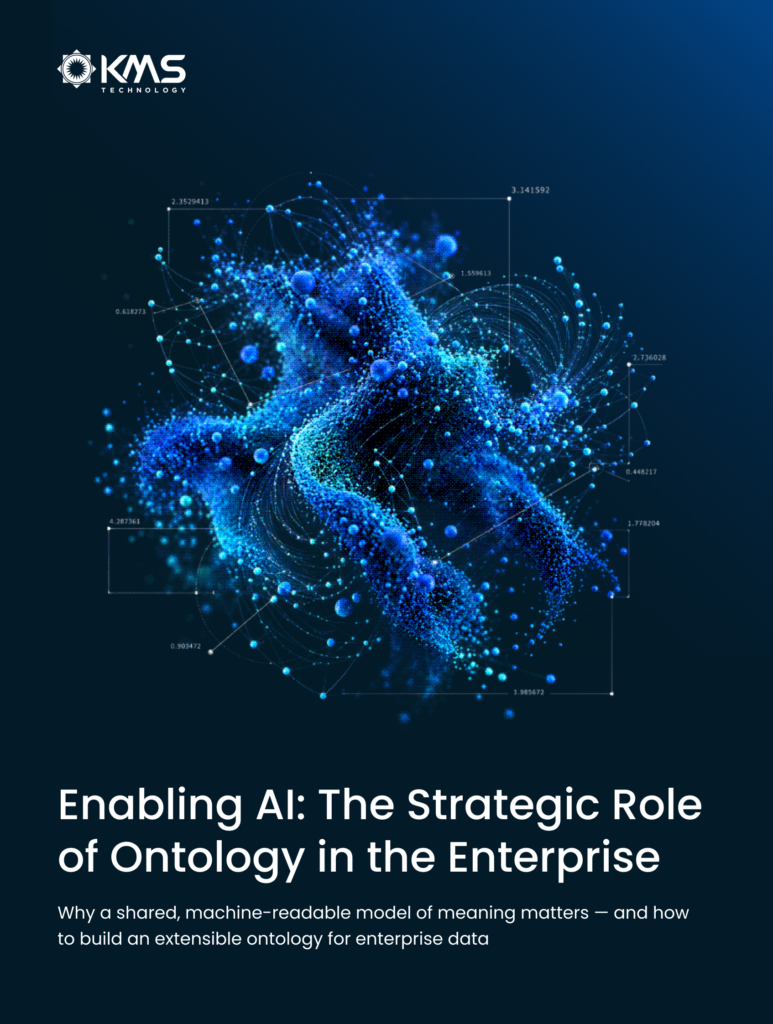
Enabling AI: The Strategic Role of Ontology in the Enterprise
Enterprise AI rarely fails for lack of data. It fails for lack of shared meaning. Learn why a shared, machine-readable model of meaning has become a strategic asset, and how to build an extensible ontology that grounds AI, cuts integration costs and grows with your business. Developed by KMS Technology.
WHAT YOU'LL GET INSIDE:
Why ontology is now a prerequisite for trustworthy enterprise AI
How ontologies differ from glossaries, taxonomies and database schemas
A practical guide to the W3C standards stack: RDF, RDFS, SKOS and OWL 2
A seven-phase process for implementing an extensible enterprise ontology
Governance models, common pitfalls and actionable recommendations
Key takeaways
What You'll Learn Inside the Playbook
One Shared Layer of Meaning
Learn how a shared ontology turns costly point-to-point integration into an N-to-1 model, where each source system maps once to a single conceptual target.
Extensible by Design
Use the open-world assumption, global identifiers, modular reuse and layered specificity to absorb new products, markets, regulations and acquisitions without rework.
Grounded, Trustworthy AI
See how connecting LLMs to a curated ontology and knowledge graph constrains their outputs and improves the accuracy of their answers. It also supports governance, auditability and the FAIR data principles.
Inside the pages
Playbook Table of Contents
01
Why Ontology Matters Now
How three pressures have made ontology a board-level data strategy topic: integration cost, governance and regulation, and grounding generative AI.
02
What an Ontology Is, and What It Is Not
Where ontology sits next to glossaries, taxonomies and thesauri, why it is not a database schema, and how the RDF, RDFS, SKOS and OWL 2 standards fit together.
03
Why “Extensible” Is the Design Goal
The four properties that let a model evolve with the business, and the principle of modeling the core narrowly and the edges loosely.
04
A Seven-Phase Implementation Process
An iterative cycle you run one domain at a time: scope and prioritize, harvest and reuse, model the core, choose a formalism, map and populate, validate, then deploy and govern.
05
Governance and Operating Model
Federated ownership, clear stewardship roles, a defined change process, and executive sponsorship tied to measurable outcomes.
06
Common Pitfalls and Recommendations
How to avoid boiling the ocean, over-formalization, vendor lock-in and neglecting the lifecycle, plus six recommendations for getting started.