The manufacturing industry has entered what many are calling the agentic era. No longer limited to dashboards and alerts, autonomous AI agents now perceive real-time IoT streams, reason across silos, plan optimal actions, and execute decisions without human touch.
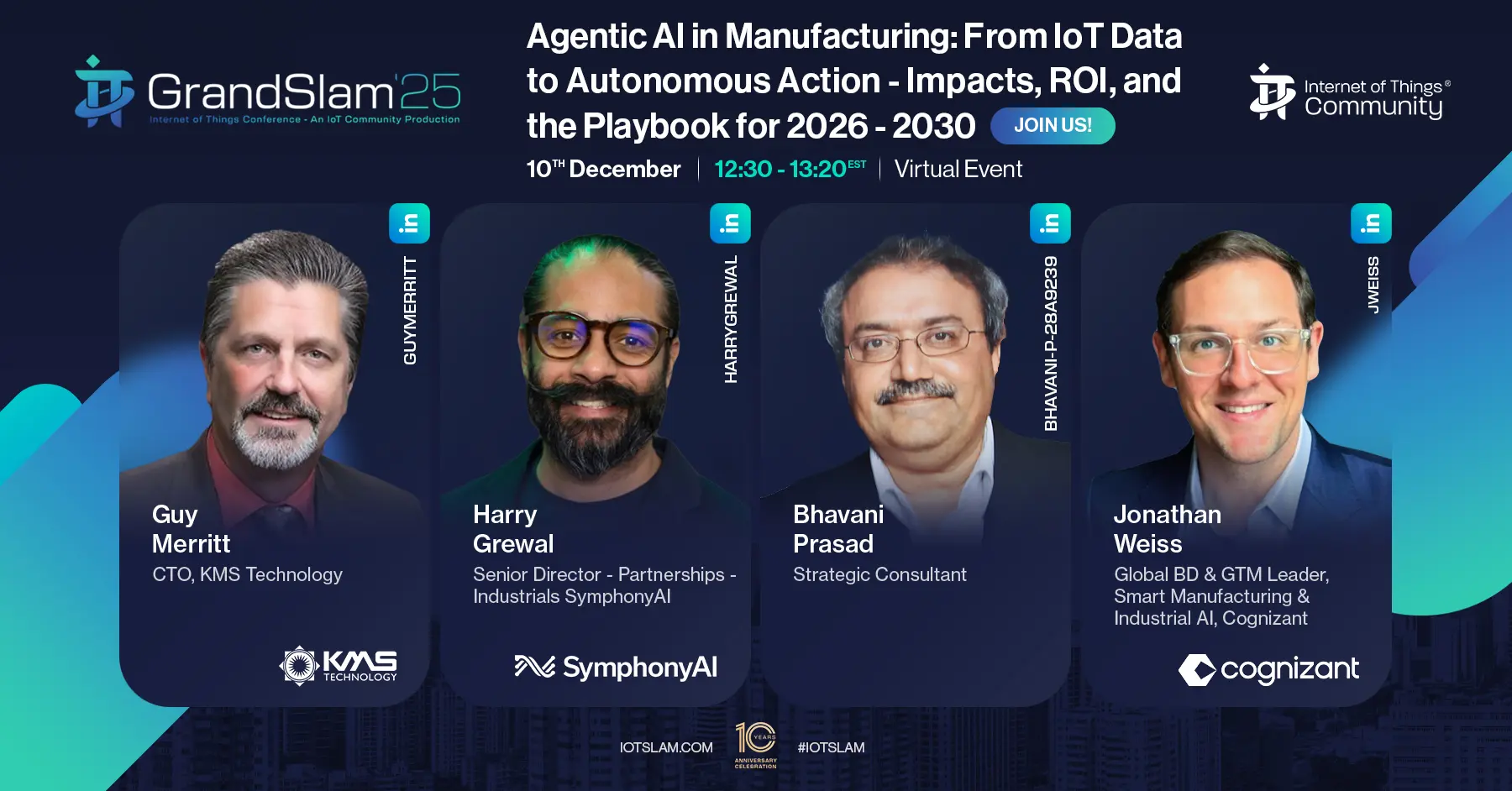
In this panel discussion at the IoT Grand Slam Conference 2025, leaders from KMS Technology, SymphonyAI, and Cognizant explored how agentic AI in manufacturing is moving manufacturers beyond dashboards and alerts toward systems that can perceive, reason, plan, and act autonomously across the factory floor. They will reveal measured outcomes, the unexpected cultural and technical hurdles, and the exact roadmap manufacturers must follow to stay competitive in an Industry 5.0 world.
Expect candid conversation on ROI realities, workforce evolution, ethical governance, and the strategic moves you can start.
Panel Speakers
Guy Merritt, Chief Technology Officer, KMS Technology
A C-suite technology executive with 35 years of engineering leadership, Guy advises manufacturers on modernizing legacy systems through IoT, cloud-native platforms, and AI-driven architectures. He is the author of Proactive Risk Management and leads technology strategy and innovation initiatives across multiple industry verticals.
Harry Grewal, Senior Director of Partnerships – Industrials, SymphonyAI
Harry is a veteran of manufacturing technology with deep experience spanning MES, WMS, industrial data platforms, and AI product strategy. At SymphonyAI, he focuses on deploying industrial AI solutions that solve real-world operational challenges.
Jonathan Weiss, Global BD & GTM Leader – Smart Manufacturing & Industrial AI, Cognizant
Jonathan partners with global manufacturers to drive operational efficiency, cost reduction, and supply chain resilience through IoT, IIoT, and AI. His experience includes large-scale transformations across companies such as GE, Pfizer, PepsiCo, Intel, and Foxconn.
What Makes Agentic AI Different
A core theme throughout the panel was that agentic AI represents a step-change from traditional industrial analytics. While predictive models, dashboards, and computer vision systems are now common, they stop short of closing the loop between insight and action. Guy explained that legacy systems were never designed to execute decisions, which leaves humans to manually interpret alerts, coordinate across systems, and respond under pressure.
Agentic AI in manufacturing fills that gap. As Guy described, these systems don’t just surface information, but also reason about context, constraints, and tradeoffs before acting. Harry reinforced this distinction by explaining that “predictive analytics tells you something is going to fail, but agents actually do the work: booking maintenance windows, ordering parts, rerouting production, and updating ERP systems.” The implication is significant: response time compresses from hours or days to minutes, and decisions become consistent rather than dependent on individual experience.
Jonathan added that the true inflection point occurs when agents operate across silos. He noted that “The value shows up when agents can communicate across enterprise systems and execute workflows. They need to move beyond generating insights and actually make things happen.” In complex manufacturing environments, that cross-system coordination is often where delays, errors, and inefficiencies accumulate.
Measuring Impact on OEE and Quality
The panel emphasized that agentic AI in manufacturing is already delivering measurable outcomes, not just pilots or proofs of concept. Harry shared a detailed example from a bottling manufacturer where agentic-driven scheduling and production orchestration were layered on top of existing systems. Without changing equipment, the manufacturer achieved a 9% OEE improvement in six months. As Harry put it, “just by making scheduling and production adjustments, we moved OEE from 67% to 76% in about six months.”
Jonathan expanded on results in quality-centric and regulated industries, where agentic AI is increasingly paired with generative AI. These systems can adapt inspection criteria as specifications and regulations evolve — something static rule-based systems struggle to do. “Agentic AI becomes powerful in regulated environments because compliance rules change and rigid systems don’t keep up,” Jonathan explained, highlighting use cases in pharmaceuticals and food manufacturing.
Guy added that speed is often the most underestimated benefit. He observed that “what used to take weeks of data work can now happen in minutes, and often with better insight,” particularly when agents are empowered to reason across historians, manuals, maintenance logs, and real-time sensor data.
The Human Factor: Trust, Change Management, and the Digital Workforce
Despite the focus on autonomy, the panel repeatedly returned to the importance of people. Agentic AI systems only succeed when humans trust the data, the reasoning, and the intent behind automated actions. Harry stressed that operators remain essential because “the human in the loop is still critical. Operators know when something doesn’t feel right, and those corrections make the AI smarter over time.”
Jonathan echoed this point, warning that trust is fragile on the shop floor. “You only get so many shots at earning trust. If the data isn’t right, the system is dead on arrival,” he said, noting that poor master data or sensor quality can derail even the most sophisticated AI initiatives.
Rather than displacing workers, the panel described agentic AI as augmenting them. Guy articulated this vision clearly, saying, “I don’t see humans being replaced. I see operators becoming superhuman, managing ten machines instead of one.” In practice, this means operators and engineers spend less time firefighting and more time supervising outcomes, validating decisions, and improving processes.
Resistance, Reaction, and Reality
The panel also addressed the cultural friction that often accompanies AI initiatives. Jonathan was candid about workforce resistance, sharing that “I’ve seen everything from full embrace to full revolt,” particularly in unionized environments where concerns about job security are front and center.
Harry observed that resistance tends to soften once workers experience tangible benefits. “When people see AI removing the work they hate, not their value, they start to lean in,” he explained, pointing to tasks like manual scheduling adjustments, repetitive data entry, and after-hours troubleshooting.
Guy reinforced that early involvement is critical, emphasizing that “if you want success, bring operators and technicians into the process from day one and you will get a better outcome.” When frontline teams help define constraints, validate actions, and provide feedback, agentic systems are more accurate, and far more likely to be adopted.
The Changing Role of Human Operators
While the panel was optimistic about autonomy, it was equally firm about boundaries. Jonathan emphasized that high-risk decisions still require human oversight, stating, “I’m still a big believer in keeping a human in the loop for governance and control,” especially in regulated or safety-critical environments.
“The human in the loop is the big thing because we still have a lot of brain trust on a plant floor. Many people know what the right thing is and what the wrong thing is. AI, as glamorous as it is, can’t always be right. So, to retrain the AI or actually give context to the AI on whether the decision made was good or not,” Harry notes.
Guy summarized this philosophy with a guiding principle: “first, do no harm.” The panel agreed that manufacturers should start with low-risk actions, such as reordering parts, adjusting schedules, or triggering notifications, before progressing toward higher-impact decisions. Harry added that autonomy must be intentional, noting that “autonomy works best when it’s bounded and purposeful,” with clear authority limits and escalation paths.
Looking Ahead: The Playbook for 2026–2030
As the session concluded, the panel agreed that agentic AI in manufacturing is no longer speculative. These agents have already reshaped manufacturing operations when deployed thoughtfully. Guy observed that “This isn’t just another hype cycle. It’s the fastest adoption of technology we’ve ever seen,” driven by advances in AI reasoning, edge computing, and integration capabilities
Harry noted that once teams experience the relief of automated decision-making, “there’s no going back,” while Jonathan emphasized that success depends on intent. “The organizations that win will apply agentic AI where it makes work safer, faster, and more resilient — not just more automated,” he said.
For manufacturers navigating Industry 5.0, the message from the panel was clear: start now, anchor initiatives in real operational problems, involve the workforce early, and scale autonomy with discipline and purpose.