NVIDIA’s GPU Technology Conference (GTC) 2026 is the world’s largest gathering of AI practitioners, researchers, and enterprise leaders. Held in San Jose in March 2026, this year’s event sent unmistakable signals about where AI is heading in the next 12 to 24 months.
Our team at KMS Technology have observed countless breakthroughs in physical AI, AI factories, agentic AI, inference, and more. What stood out was not just the pace of innovation, but the shift in focus.
Over the past few years, many teams explored AI through pilots and proofs of concept. At GTC, the conversation has clearly moved beyond that phase. Companies are now focused on making AI work reliably in production, at scale, and under real business constraints.
This article reflects five defining signals from GTC 2026 and translates them into strategic implications for technology leaders navigating this shift.
- Signal #1 – AI Becomes Infrastructure: From add-on feature to core architectural layer
- Signal #2 – Autonomous Agents Take Center Stage: AI shifts from assistant to autonomous worker
- Signal #3 – Inference is the New Battleground: Speed, cost, and reliability at production scale
- Signal #4 – Physical AI Breaks Out of the Screen: Robotics, autonomous systems, and digital twins converge
- Signal #5 – The Execution Gap is the Real Problem: When technology is ready but deployment capability is not
The AI Inflection Point
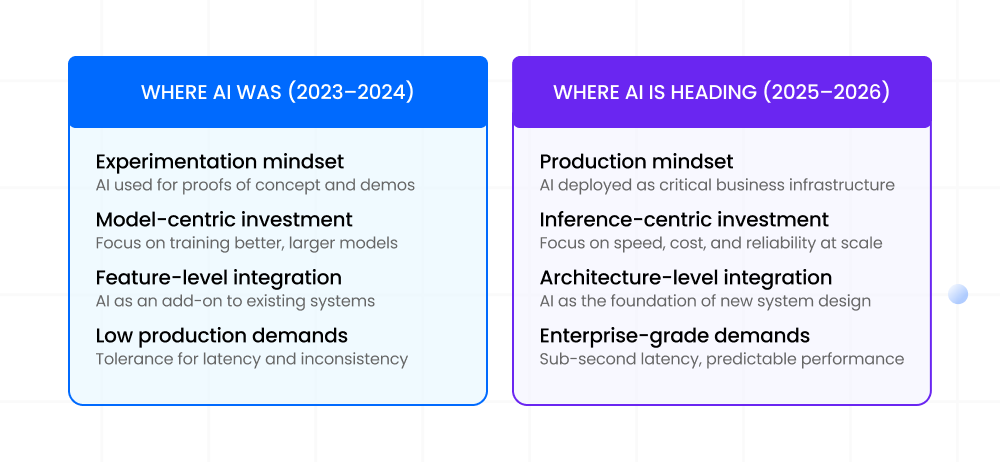
GTC 2026 opened with a sense of urgency. Jensen Huang’s keynote framed the moment precisely: AI has moved from Phase 1 (Experiment) through Phase 2 (Pilot) and is now entering Phase 3 (Production).
“AI success will not come from adopting technology and tools, but from building systems that execute reliably at scale.”
– GTC 2026 keynote theme
This shift was visible across the event.
Sessions on model training have been displaced by sessions on inference optimization, deployment architecture, and agent orchestration. The audience has shifted from researchers to engineers, architects, and enterprise decision-makers. The conversation has moved from ‘what is possible?’ to ‘how do we run this in production?
Signal #1: AI Becomes Infrastructure
One of the clearest patterns we observed across sessions and conversations at GTC is how AI is being reframed at the architectural level.
For the past several years, AI has been treated as a feature added to existing applications to make them smarter. At GTC 2026, the framing was definitively different: AI is the infrastructure on which the next generation of applications will be built.
NVIDIA and its ecosystem partners presented a five-layer AI stack that replaces the traditional three-tier application model. In this new architecture, GPU infrastructure, runtime systems, AI models, autonomous agents, and end-user applications form an integrated stack.
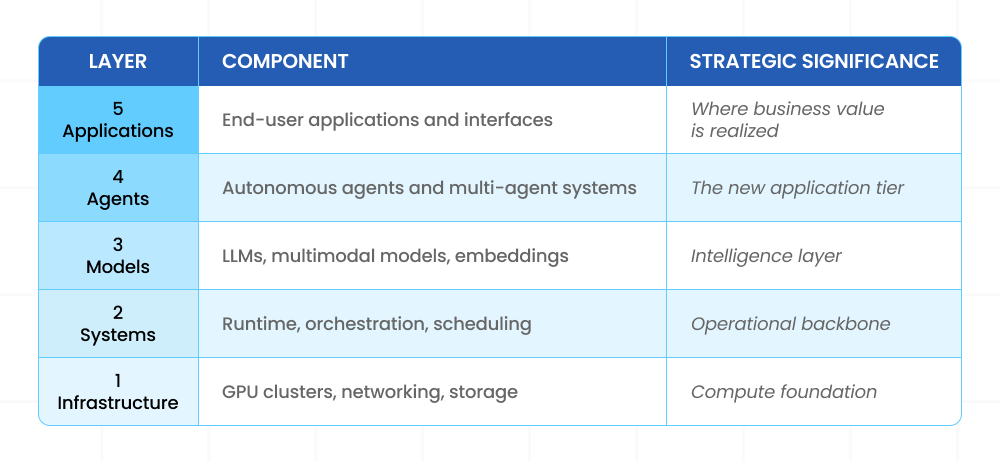
Organizations that continue to treat AI as a point solution, like adding a chatbot or a recommendation engine, risk falling behind at the architectural level. In contrast, those that build AI into their core systems from the ground up will be in a much stronger position over time.
STRATEGIC IMPLICATION: The question is no longer how to add AI into existing systems. It is how to design systems that are built around AI from the start. This shift influences everything, from how organizations make technology investments to how they hire and structure their teams.
Signal #2: Autonomous Agents Take Center Stage
GTC 2026 marked a turning point in how AI systems are designed. Over the past three years, the dominant approach has been the copilot model, where AI supports a human in completing a task. What we’re seeing now is a shift toward something more capable: autonomous agents that can take action, not just offer suggestions.
Session after session at GTC described multi-agent architectures in which a coordinating orchestrator agent delegates work to specialized sub-agents, each with access to specific tools, APIs, and data sources. These systems do not require real-time human interaction. They operate asynchronously, complete multi-step workflows, and loop back for human review only at defined decision points.

What’s changing, and why it matters
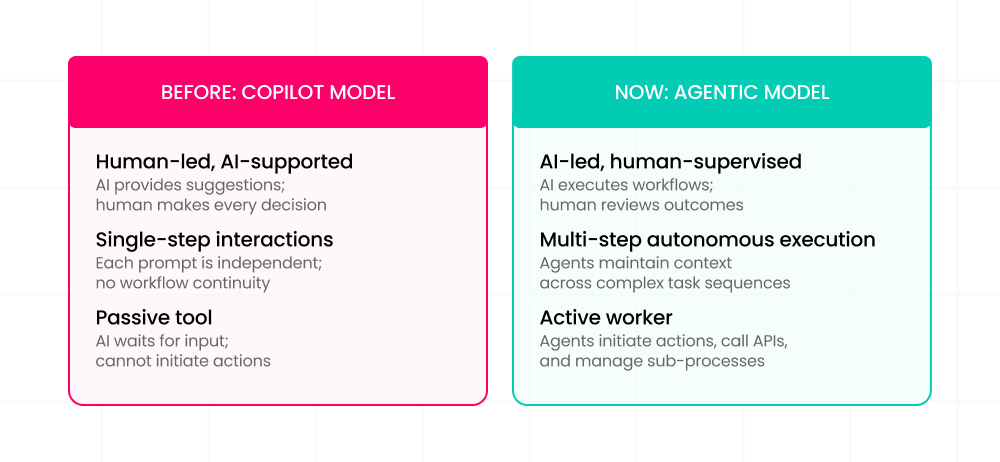
For organizations that have invested heavily in copilot-style AI, the next step is to build capabilities around agent orchestration. This means designing workflows that agents can handle end-to-end, setting up evaluation systems to validate outputs, and establishing the right governance for human oversight.
STRATEGIC IMPLICATION: The engineer’s role is evolving from code writer to agent orchestrator. Teams that learn to design, deploy, and supervise autonomous agent systems will be the highest-leverage contributors in an AI-native organization.
Signal #3: Inference is the New Battleground
In 2023, the AI conversation was dominated by training: which model, trained on what data, with how many parameters. By GTC 2026, that conversation has been displaced by inference: how fast, how cheap, how reliably can AI run in production?
As AI moves from experimentation to production, the economics change entirely. Training costs are one-time capital expenses. Inference costs are recurring operational expenses that scale with every user request. At production scale, it quickly becomes the dominant expense, and performance has a direct impact on user experience.

Why Inference Became the Priority
There are a few reasons behind this change:
- Latency expectations: What was acceptable during pilots, like a 3 to 5 second response, no longer works in production. Users now expect near-instant responses.
- Cost pressure: At scale, inference token costs become material operating expenses. Every millisecond and every token counts against the unit economics of AI-enabled products.
- Reliability demands: Enterprise deployments require consistent, predictable performance under load, introducing a whole different level of engineering complexity.
STRATEGIC IMPLICATION: Organizations evaluating AI investments should expand their evaluation criteria beyond model quality to include inference architecture: latency profiles, cost per query, throughput under load, and the total cost of running AI reliably at scale.
Signal #4: Physical AI Breaks Out of the Screen
GTC 2026 devoted significant keynote time to what NVIDIA calls Physical AI.
Physical AI is the application of AI to systems that operate in the real world: robots, autonomous vehicles, industrial machinery, and the digital twins that simulate them.
Multiple GTC exhibitors demonstrated production-grade physical AI deployments: autonomous robots operating in logistics warehouses, AI-controlled industrial processes in semiconductor manufacturing, and digital twin environments used to train and test AI models before real-world deployment.
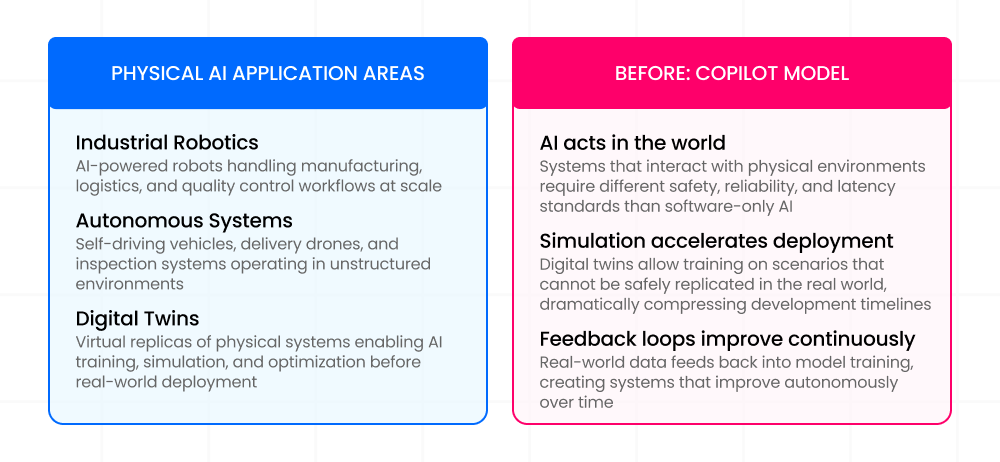
For asset-heavy industries such as healthcare, manufacturing, logistics, and utilities, Physical AI represents a step change in automation capability. Tasks that were previously difficult to automate, especially those involving physical interaction or unpredictable conditions, are now becoming viable for AI systems.
STRATEGIC IMPLICATION: Physical AI is not something to wait on. Organizations that start building the necessary capabilities now will be better positioned to adopt it.
Signal #5: The Execution Gap is the Real Problem
One of the most important takeaways from GTC 2026 was not about how advanced AI has become, but about the gap between what it can do and what organizations are actually able to deploy. Multiple sessions and panel discussions converged on a stark finding: only 15% of AI proofs of concept successfully reach production deployment.
“The challenge is not the technology itself. Organizations already have access to powerful AI tools. The real bottleneck is execution, especially when it comes to deploying these systems at scale.”
– GTC 2026 keynote theme
The Four Barriers to Enterprise AI Deployment
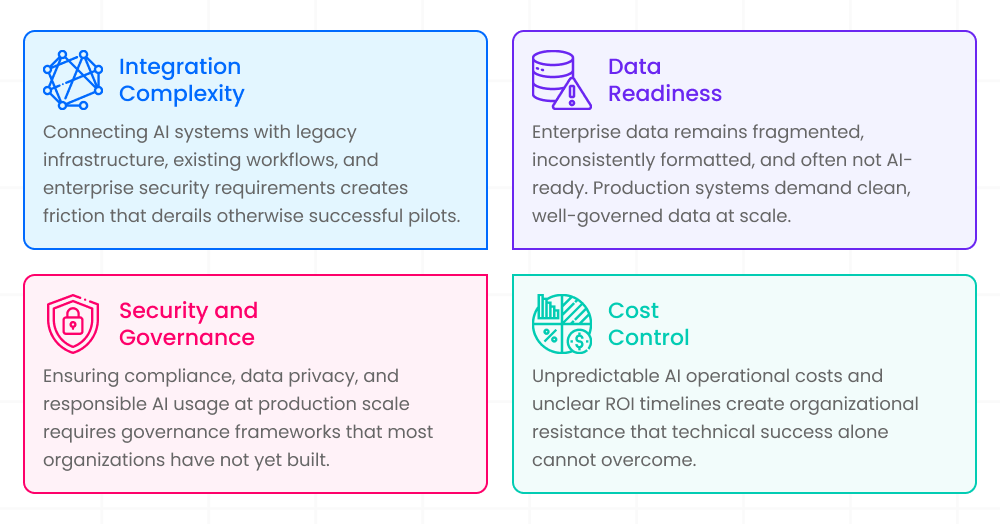
Organizations that succeed in closing the execution gap share a common trait: they have built production readiness as an organizational capability, not just a technical one. This means dedicated AI platform engineering teams, robust evaluation and monitoring infrastructure, and change management programs that bring operations teams along with technology teams.
STRATEGIC IMPLICATION: Investing in AI technology without investing in AI deployment capability is a losing strategy. In the near term, the real win will not come from more advanced models, but from the ability to consistently take AI from pilot to production.
Key Takeaways for Technology Leaders

The five signals from GTC 2026 compose a coherent strategic picture. AI has matured past the experimental phase and is entering a period of enterprise-scale deployment. The organizations that will lead in this environment share several characteristics.
1. They think in systems
They are redesigning core business processes around AI capabilities rather than adding AI to existing processes. Architecture decisions are made with a five-year AI roadmap.
2. They invest in orchestration over models
They recognize that the ability to coordinate multiple AI components (agents, tools, APIs, data sources) delivers more value than any single model improvement. Orchestration is their competitive moat.
3. They build deployment muscle
They treat AI deployment as a core engineering discipline, with dedicated platform teams, evaluation frameworks, monitoring infrastructure, and governance processes.
4. They move from pilots to programs
They have developed repeatable methodologies for taking AI from proof of concept to production, and they apply them systematically across the organization rather than running isolated pilots.
The Bottom Line
GTC 2026 was less about what AI might become and more about where it already is. The focus has shifted to AI in production, and the growing gap between organizations that have made that transition and those still experimenting.
The five signals discussed here are not separate trends. They are all part of a larger shift: AI is becoming foundational to how enterprise systems are designed and run.
The next 24 months will be critical, opening up a time when competitive positions will take shape. Organizations that can build production-grade AI execution capability in this period will hold structural advantages that compound over time.
“The question for every technology leader is not whether to move to AI-native operations. It is whether to move in the next 12 months or be moved by the organizations that do.”
At KMS Technology, we partner with enterprises to operationalize AI at scale. Contact us to discuss how we can accelerate your path to AI-native operations.