
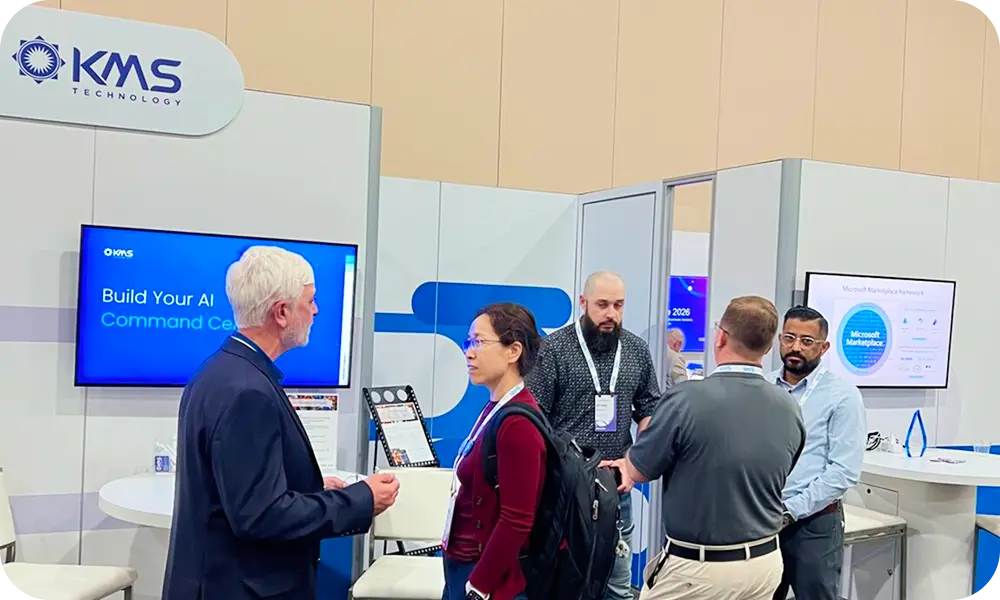
SAS Innovate 2026 in Grapevine, Texas brought together:
2,000
data and AI professionals
200
breakout sessions
50
workshops
100
live demonstrations
This year’s overarching theme, Operationalizing AI at Scale, was not simply a tagline. This theme was reflected in every keynote, technical deep dive, and customer story shared throughout the event. As an AI consulting and engineering partner, KMS Technology was on the ground, with CTO Guy Merritt participating as a featured speaker.
The conversations we had and the sessions we attended all pointed in the same direction. The industry is moving beyond experimentation, and the focus has shifted decisively toward execution.
Below are the five most important takeaways from the event, and what they mean for organizations serious about turning AI investment into measurable outcomes. A successful enterprise AI strategy now requires more than selecting models or launching pilots. It requires the data, engineering, governance, and operating discipline needed to turn AI investment into reliable business outcomes.
Takeaway 1: Industrial AI Is Becoming a Core Enterprise AI Strategy Use Case
One of the standout sessions of SAS Innovate 2026 was presented by KMS Technology CTO Guy Merritt: “Build an Industrial AI Command Center – AI-Driven Worker Safety.”
The problem space is both urgent and persistent. While AI capabilities have advanced rapidly, many industrial environments still lack real-time visibility into operations and worker safety. As a result, preventable incidents continue to occur.
The session introduced KMS Technology’s Worker Safety solution, developed in partnership with SAS. By combining SAS’s advanced data analytics and AI capabilities with KMS Technology’s engineering and deployment expertise, Worker Safety continuously monitors worksites using computer vision, AI-driven insights, and historical data to identify risks and unsafe behaviors in real time, before incidents occur.
What makes this approach compelling is its practicality. Organizations don’t need to rip and replace existing infrastructure. Worker Safety is designed to layer onto what factories and industrial sites already have, including cameras, sensors, operational data, and turn that existing investment into an active safety intelligence system.
The session drew strong interest from manufacturing, energy, and logistics attendees. Industrial AI is now operational, deployable, and already protecting workers.
Takeaway 2: Enterprise AI Strategy Must Move Beyond Pilot Projects
If there was one meta-theme running through every keynote and breakout at SAS Innovate 2026, it was this: the experimentation phase is over. SAS CTO Bryan Harris opened the conference by making clear that the conversation has fundamentally shifted from proofs-of-concept to production-grade, governed AI systems delivering measurable outcomes.
Session after session highlighted the gap between organizations that have crossed this threshold and those still stuck in pilot mode. Customer stories from financial services, healthcare, retail, and manufacturing showed AI driving real decisions, in real time, not sitting in sandbox environments waiting for executive sign-off.
For KMS Technology, this is the most important signal from the event. The competitive advantage is shifting from having an AI strategy to having an AI execution capability. The table below maps the four stages of enterprise AI maturity, and what it takes to move through each one.
Enterprise AI Maturity Model
| Maturity Level | Characteristics | What’s Needed to Advance |
|---|---|---|
| Experimenting | PoC projects, siloed data, no production deployments | Governance framework + MLOps infrastructure |
| Scaling | Selectively production use, inconsistent governance, limited monitoring | Enterprise orchestration + deployment pipelines |
| Operationalizing | AI embedded in core workflows, real-time decisioning, monitored outcomes | Continuous improvement loops + org alignment |
| Leading | AI-driven differentiation, governed agents, measurable ROI | Culture of experimentation + trusted AI by design |
Organizations at the ‘Operationalizing’ stage are today’s competitive benchmark. Most enterprises are still at ‘Scaling’ or below.
Organizations that can bridge the gap between model development and enterprise deployment, with the right governance, integration, and change management in place, will pull ahead in 2026 and beyond. The organizations moving ahead are not simply investing more in AI. They are building an enterprise AI strategy that connects model development, production infrastructure, governance, workflow integration, and measurable value.
Takeaway 3: Agentic AI Is Moving Into Enterprise Workflows
Agentic AI was arguably the hottest topic across the entire conference. But unlike much of the industry chatter, SAS Innovate 2026’s sessions on the subject were grounded in working implementations, not theory. The session on Agentic AI in SAS Customer Intelligence 360 showed agents operating directly within marketing workflows, orchestrating campaigns, surfacing insights, and acting on decisions in real time.
What distinguished SAS’s approach was an explicit focus on governance and control. Agentic systems that operate without human oversight or auditability create enormous enterprise risk. The path to production-ready agents runs directly through robust governance frameworks, defining when agents act autonomously, when they escalate, and how every decision can be traced and audited.
The table below maps five high-value agentic AI use cases, the capabilities they unlock, and the governance requirements that must be in place before going to production. Agentic AI becomes part of an enterprise AI strategy only when organizations define where agents can act autonomously, when they must escalate, and how their decisions remain traceable.
Agentic AI: Use Cases, Capabilities & Governance Requirements
| Use Case | Agentic Capability | Governance Requirement |
|---|---|---|
| Marketing Orchestration | Campaign creation, journey optimization, real-time decisioning | Audience data controls, consent management, override policies |
| Fraud Detection | Autonomous alert triage, case escalation, rule updates | Full auditability of every decision, human-in-loop thresholds |
| Supply Chain Ops | Demand sensing, rerouting, supplier negotiation triggers | Override controls, SLA monitoring, rollback protocols |
| Customer Service | Ticket resolution, knowledge retrieval, escalation routing | Tone guardrails, escalation policy, PII handling |
| Risk & Compliance | Regulatory change monitoring, exposure flagging, automated reporting | Explainability logs, model version control, sign-off workflows |
Each use case has a clear business case, but each also carries distinct governance obligations that must be designed in, not added after deployment.
Deploying agentic systems is an enterprise architecture challenge. The organizations winning here are treating agent deployment with the same rigor applied to any mission-critical system.
Takeaway 4: Trusted AI Is Essential to Enterprise AI Strategy
A recurring theme across the financial services and healthcare tracks was the growing recognition that trustworthy AI is a competitive differentiator, not just a regulatory checkbox. A SAS study cited during the conference found that only 11% of banks have fully cracked the code on trustworthy AI, a striking number that drew audible reactions in the room.
The sessions on fraud detection and risk management were particularly instructive. As AI-driven fraud patterns grow more sophisticated, organizations that have embedded explainability and auditability into their models are responding faster and with more confidence. Those relying on black-box systems are increasingly unable to satisfy regulators, or their own risk committees.
The table below breaks down the five core dimensions of trusted AI, what each means in practice, and how SAS Innovate 2026 sessions signaled the industry is approaching each dimension right now. For regulated industries, trusted AI is no longer a separate compliance initiative. It is a core requirement of enterprise AI strategy from the earliest stages of design.
The Five Dimensions of Trusted AI
| Dimension | What It Means | Why It Matters | SAS Innovate Signal |
|---|---|---|---|
| Explainability | Model decisions interpretable by humans | Regulatory scrutiny, internal risk review | Decisioning sessions showed full audit trails as default |
| Fairness | Outputs don’t systematically disadvantage groups | Legal liability, brand risk | Healthcare and financial tracks emphasized bias testing |
| Robustness | Models perform reliably under adversarial or shifted data | Operational continuity, fraud resilience | Fraud management sessions highlighted drift detection in production |
| Transparency | Stakeholders understand how and why AI is used | Customer trust, employee adoption | Governed agent workflows with visible decision logic |
| Accountability | Clear ownership of AI outcomes and errors | Regulatory compliance, governance | Decisioning platform designed for human-in-loop sign-off |
This takeaway shapes how the KMS Technology team approaches every engagement in regulated industries. Governance architecture needs to be designed from day one, not retrofitted after deployment.
Takeaway 5: Digital Twins, IoT, and Quantum AI Are Shaping Enterprise AI Strategy
Not every session at SAS Innovate 2026 was about what’s happening right now. Two sessions stood out for their forward-looking content and generated some of the most animated discussion across the four days.
The session on digital twins and conversational AI demonstrated how SAS is combining AutoML, IoT data streams, and natural language interaction to enable real-time simulation of complex operational environments, without requiring deep coding expertise.
The Quantum AI Toolbox session positioned quantum not as a moonshot but as a systematic program to build organizational literacy ahead of the hardware maturation curve.
The table below summarizes where each technology sits on the maturity curve today and the most practical entry point for enterprise teams.
Emerging AI Technologies: Maturity & Entry Points
| Technology | Maturity Today | Where to Start |
|---|---|---|
| Digital Twins | Production-ready for manufacturing, supply chain, IoT environments | Map a high-variability operational process; integrate real-time sensor data |
| Conversational AI + AutoML | Widely available; enables non-technical users to build and query models | Deploy a low-code analytics layer for domain experts in one business unit |
| Hybrid Quantum-Classical AI | Early-stage but active R&D; SAS Quantum AI Toolbox now available | Identify optimization problems (routing, portfolio) as candidate test cases |
| Agentic AI + IoT Integration | Emerging in production; governance tooling maturing rapidly | Pilot a monitored agent in a low-risk operational workflow with full audit |
The organizations that will lead in 2028–2030 are building experimentation capability with these technologies today.
The gap between leading and lagging organizations in AI is often learning velocity. The organizations that are already running experiments, even at small scale, will have an enormous advantage when these technologies mature.
What This Means for Your AI Journey
SAS Innovate 2026 reinforced what the KMS Technology team sees every day with clients: AI has become a systems-level discipline, requiring data, engineering, operations, and organizational alignment.
The window for competitive differentiation through AI is real, but it’s compressing. The organizations that will look back on 2026 as a turning point are the ones acting with urgency now: not just building models, but building the infrastructure, governance, skills, and culture to deploy them at scale.
Whether the challenge is moving from proof-of-concept to production, building trusted AI systems in regulated environments, or deploying industrial AI to protect workers, the KMS Technology team brings both the strategy and the engineering to make it real.
- Move from proof-of-concept to production-grade AI systems
- Design and implement scalable AI architectures
- Embed governance and responsible AI practices from the start
- Build intelligent, orchestrated systems that drive real decisions
The next wave of AI is closer than it appears, and KMS Technology is ready to help you take the leap.
FAQ
What is an enterprise AI strategy?
An enterprise AI strategy is a structured plan for using AI to improve business outcomes across the organization. It defines priority use cases, data and technology requirements, governance controls, operating models, workforce readiness, and the metrics used to measure value.
Why do enterprise AI pilots fail to scale?
Many AI pilots fail to scale because organizations prove that a model can work without preparing the environment needed to run it in production. Common barriers include fragmented data, weak system integration, unclear ownership, insufficient governance, limited user adoption, and no clear path to measurable business impact.
What does enterprise AI execution mean?
Enterprise AI execution is the ability to translate AI strategy into real operational capability. It includes deploying production-ready systems, integrating AI into workflows, establishing governance, preparing teams, and measuring whether AI improves decisions, efficiency, safety, revenue, or customer experience.
How does agentic AI fit into an enterprise AI strategy?
Agentic AI can help organizations automate multi-step workflows by allowing AI systems to interpret information, plan actions, use approved tools, and escalate decisions when needed. It should be deployed with clear permissions, human oversight, traceability, and governance controls.
Why is trusted AI important for enterprise AI strategy?
Trusted AI is essential because enterprises need systems that are explainable, secure, accountable, and auditable. This is especially important in regulated industries where organizations must understand how AI outputs were generated, what data informed them, and whether the system can withstand risk or regulatory review.
What capabilities are needed for an enterprise AI strategy?
Core capabilities include high-quality data, scalable AI architecture, integration with enterprise systems, security controls, model monitoring, governance frameworks, change management, workforce skills, and outcome-based measurement.
TAGS

Written by
CTO
Guy is an award-winning author and experienced technology executive who has led strategy, product innovation, engineering, and cloud-based solutions across Deloitte, startups, and a range of global industries.