
For over a decade, IoT sensors and predictive analytics have given manufacturers a clearer view of their operations than ever before: vibration spectra from bearing housings, OPC-UA telemetry from PLCs, computer-vision defect alerts on the line. Yet most of that intelligence still stops at the alert. A human reads the dashboard, opens a ticket, calls a supplier, schedules the repair. The signal arrives in milliseconds. The response takes hours or days.
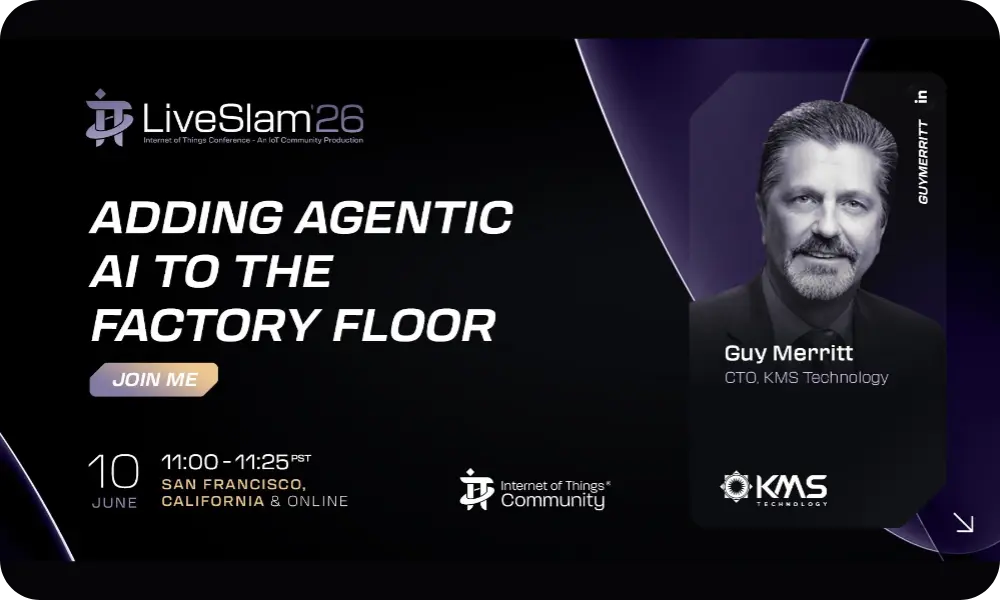
At IoT Slam Live 2026, IoT Community’s hybrid flagship event bringing together enterprise and industrial leaders to share real world outcomes, architectures, and roadmaps at the intersection of 5G, mobile edge compute, GenAIoT, and agentic AI, Guy Merritt, Chief Technology Officer at KMS Technology, walked attendees through how LLM-driven agents can close that gap and turn IoT data streams into autonomous, governed action across the value chain.
Throughout the session, Guy covered what agentic actually means beneath the marketing, how tools and agents differ from retrieval augmented generation, the control loop that turns a predicted failure into a completed work order without a human touching a keyboard, and the guardrails that keep all of it safe on a regulated shop floor. Along the way, he shared results from a real aviation maintenance, repair, and overhaul deployment and a practical roadmap for getting started.
The $3 Trillion Gap
Manufacturers already have a strong base of AI on the floor. Computer vision has handled quality inspection for over two decades. Predictive maintenance models have been forecasting remaining useful life for nearly thirty years. Anomaly detection flags variation from the norm in real time. None of that is new, and none of it, in Guy’s telling, is the problem.
The problem is what happens after the system speaks up. “Almost every one of those systems, they notify you of a potential problem, or they notify you of a problem,” Guy explained. Even generative AI, layered on top of these systems, still just produces a better worded version of the same note to a technician. If that note gets ignored, the machine still fails.
That gap between detection and action is where roughly $3 trillion in global unplanned manufacturing downtime accumulates every year. The goal isn’t more visibility. Manufacturers already have plenty of that. The goal is to reduce the duration and frequency of the downtime itself, which means someone, or something, has to actually act on what the data is saying.
What Agentic Actually Means
Guy has been building AI systems since 1992, and he was direct about how loosely the term “agentic” gets used today. To him, agentic AI introduces three capabilities that traditional manufacturing AI never had: the ability to understand context, reason about it, and plan a sequence of actions on its own.
That planning piece is where things get genuinely new. Guy described watching a client’s knowledge graph system flag, unprompted, that a configuration change meant a batch of tests needed to be rerun. “We did not tell it to do that,” he said. “This planning that an LLM can bring in is unbelievable.” Traditional software follows rules human wrote. An agentic system sequences its own plan, which means manufacturers are handing over a piece of control they’ve never handed over before.
That shift changes the operator’s role fundamentally. Manufacturing has relied on humans in the loop, checking and approving every automated recommendation before it happens. Agentic systems move toward what Guy calls humans on the loop: a supervisory role where people orchestrate and advise rather than approve every step. It’s a meaningful change for an industry that has always preferred deterministic, rules-based systems, where a given temperature or oil pressure produces one predictable response.
40%
of enterprise applications are projected to include task-specific AI agents by the end of 2026.
Source: Gartner
Guy acknowledged that handing a probabilistic system this kind of authority makes people uneasy, particularly in regulated environments. His response reframes the discomfort rather than dismissing it. “The agentic system is what I call a human emulator,” he said. “We’re all scared of AI, of what it’s doing. It’s doing nothing but emulating what we do.” Ask five engineers to diagnose the same problem and you’ll get a range of answers too. The difference is that manufacturers are used to their floor technology being exacting, and agentic AI asks them to trust something that reasons more like a person than a rulebook.
Tools vs. RAG: Single Actions With Guardrails
One of the most technical and practical parts of the session was Guy’s distinction between tools and retrieval-augmented generation (RAG). Both matter, but they solve different problems.
RAG works best against data that barely changes: policies, procedures, reference documentation. It’s not built for the firehose of time-series data coming off a sensor. For that, agents need tools: discrete functions, like “create work order,” that take a defined set of parameters and do exactly one thing before stopping.
That constraint is precisely what makes tools useful as a guardrail. “It keeps a lot of control on the floor, but it also allows you to get stuff in real time,” Guy explained. Because a tool call is narrowly scoped and well documented, in his words, the better the comments inside the tool’s code, the better the LLM understands when and how to invoke it. Tool-calling gives manufacturers a much faster and more controllable way to let an agent act than a general-purpose retrieval system ever could.
The Observe, Reason, Act, Reflect Loop
The core of Guy’s session was the control loop that turns raw sensor data into a completed, audited action:
Observe
The system detects a condition, such as a machine learning model flagging an anomalous vibration signature.
Reason
An LLM interprets what the signal means and, unlike a legacy system that would simply generate a notification, begins building a plan to resolve it.
Act
The agent invokes its tools: checking ERP inventory for a replacement part, ordering it if it’s not on hand, and scheduling the repair in the CMMS, all without waiting on a human to read a dashboard.
Reflect
That reflect step is what makes the system genuinely closed loop rather than a one-off automation. “It will reflect upon that and say, I wanted to do this, but last time I had this problem, there’s a record that wasn’t the right action, do this instead,” Guy said. Without that memory, in his framing, the system isn’t truly agentic no matter how autonomous a single action looks.
He also drew a clear line between an algorithm and an agent. An algorithm runs a finite set of steps and stops. An agentic system runs until it hits a defined stop condition: the goal is reached, an iteration limit is met, a threshold triggers a handoff to a human, or the system recognizes bad input, such as a flatlined sensor, and refuses to act on it as though it were real.
Architecture: Why the Gateway Layer Can Never Be Crossed
Guy’s architecture extends the familiar edge, orchestration, platform, and analytics model most manufacturers already run, adding an agent layer on top and an MCP-based tool gateway in between. Agents sit above the gateway. Source systems like MES, ERP, CMMS, and WMS sit below it, and the gateway is the boundary that must never be crossed in either direction.
“This layer can never go past this layer,” Guy said, describing the gateway not as a convenience but as a protection layer, buffering agents from doing damage directly to production systems. Applied to predictive maintenance specifically, the shift is straightforward: take the existing anomaly-detection model, connect it to a predictive maintenance agent with tool access into ERP and CMMS, and the same forecasted failure that used to generate a notification now generates a validated work order, a parts purchase order, and a scheduled downtime window on its own.
The Business Case Is Time Compression, Not Cost Savings
Guy was pointed about how manufacturers should evaluate the ROI of agentic AI. “Don’t look for the cost savings using these methods,” he advises clients. “What you really want to look for is time compression. Cost savings emerge because you’re doing things faster.”
He pointed to KMS’s own software development practice, where agentic approaches to engineering have produced productivity gains of three to four times. When clients raise the obvious objection, what happens when the agent gets it wrong, his answer is simple: redo it, and you’re still ahead of the traditional timeline. On the factory floor, that same logic applies to throughput today and to a longer-term shift in the ratio of operators to machines, as self-optimizing systems let fewer people supervise more equipment.
A Practical Roadmap: Crawl, Walk, Run
Guy closed with a warning against the most common way these initiatives fail: starting with a proof of concept. “Those don’t work,” he said. Instead, he recommends an 8 to 12 week pilot, or proof of value, anchored to one real, high-ROI process rather than a hypothetical one. Learn from that pilot before scaling to the next process.
As IoT and predictive maintenance systems mature into their next phase, Guy’s message was that the technology to close the gap between detection and action already exists. What manufacturers need now is the architecture, the guardrails, and the discipline to start small and prove it on a real problem first.
FAQ
1. What is agentic AI on the factory floor?
Agentic AI on the factory floor refers to LLM-driven agents that observe IoT and sensor data, reason about what it means, plan a sequence of actions, and execute those actions through defined tools, such as ordering a part or scheduling maintenance, without requiring a human to manually interpret every alert.
2. How is agentic AI different from traditional predictive maintenance?
Traditional predictive maintenance systems detect a potential failure and notify a human, who then has to interpret the alert and coordinate a response. Agentic AI takes the same prediction and autonomously checks inventory, places orders, and schedules the repair, closing the gap between detection and resolution.
3. Why is an MCP gateway important in an agentic architecture?
An MCP-based tool gateway sits between the agent layer and core systems like MES, ERP, CMMS, and WMS, giving agents safe, typed access to those systems without allowing them to interact with source systems directly. This protects production environments from unintended or unsafe actions.
4. How should manufacturers measure the ROI of agentic AI?
Rather than focusing purely on cost savings, manufacturers should evaluate agentic AI based on time compression, or how much faster a decision, action, or result can be achieved. Cost savings tend to follow naturally once processes move faster and become more consistent.

Written by
CTO
Guy is an award-winning author and experienced technology executive who has led strategy, product innovation, engineering, and cloud-based solutions across Deloitte, startups, and a range of global industries.