

Agentic AI is a new generation of artificial intelligence that can reason, plan, make decisions, and take actions to achieve a specific goal with minimal human intervention. Systems can orchestrate multi-step workflows, use external tools, and adapt their actions based on changing conditions.
For business leaders, this shift represents a major opportunity. Agentic AI has the potential to automate complex business processes, improve operational efficiency, accelerate decision-making, and scale knowledge work in ways that traditional automation cannot.
However, successful Agentic AI adoption requires far more than deploying a new model. Organizations need clean and accessible data, well-defined business processes, connected enterprise systems, and governance frameworks that ensure security, compliance, and human oversight.
In this guide, you’ll learn what Agentic AI is, how it differs from Generative AI, where it delivers the greatest business value, and how to prepare your organization to become truly agentic-ready.
Key Takeaways
- Agentic AI doesn’t replace Generative AI, but adds reasoning, planning, and autonomous action on top of it, turning a “reasoning engine” into a system that executes full workflows end-to-end.
- Agentic AI succeeds or fails on fundamentals, not model quality: clean and accessible data, clearly mapped workflows, connected systems, and governance that scales with the technology.
- The stakes are real: MIT research shows 95% of GenAI pilots never deliver measurable P&L impact, and Gartner expects 40% of agentic AI projects to be cancelled by 2027 — almost always due to premature deployment, not immature AI.
- There’s no single “best” framework. LangChain, LangGraph, AutoGen, CrewAI, and others each fit different needs — choose based on programming model, multi-agent requirements, and enterprise readiness, not hype.
- Security, human-in-the-loop design, and EU AI Act compliance have to be built in from day one. Bolting them on after a pilot succeeds is the fastest way to stall at the pilot stage.
- Done right, the upside is measurable: McKinsey finds organizations embedding AI agents into workflows achieve 20–60% productivity gains and ~30% faster task turnaround versus GenAI-only deployments — but only when starting from one well-scoped, low-risk use case.
What Is Agentic AI? Definition and Core Capabilities
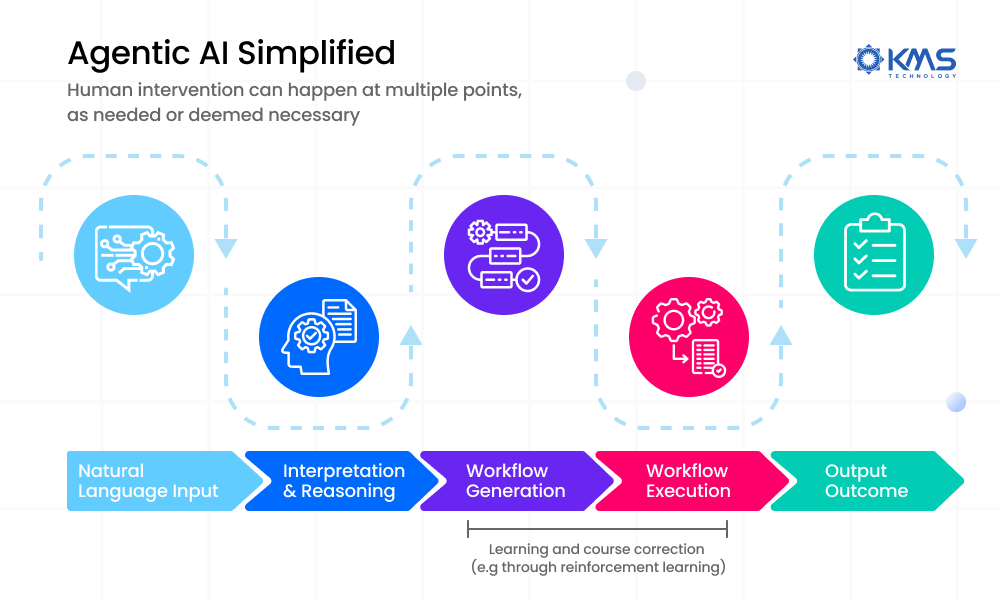
Agentic AI refers to artificial intelligence systems that don’t just generate outputs, but can also plan, make decisions, and take actions toward a defined goal. These systems combine the reasoning power of Generative AI with additional layers of autonomy, orchestration, and tool use.
At the core, generative models such as large language models (LLMs) act as “reasoning engines,” producing language, code, or analysis. Agentic AI can gather relevant data and extend the capabilities of AI by enabling the system to:
- Perceive inputs from data, APIs, or the environment
- Plan multi-step strategies to achieve objectives
- Act by invoking external tools, software systems, or APIs
- Adapt through feedback loops and learning from outcomes
In practice, this means Agentic AI systems can execute workflows end-to-end rather than stopping at a draft or suggestion. For example, a customer service agent can not only draft a response but also look up account details, issue a refund, and escalate if needed.
This autonomy is achieved through a combination of advanced techniques, including machine learning, natural language processing, and reinforcement learning. AI agents are trained to perceive their environment, reason about possible actions, and learn from their experiences, enabling them to operate with increasing independence.
Agentic AI vs. RPA: Key Differences and When to Choose Which
Robotic Process Automation (RPA) and agentic AI are often lumped together under the label “automation,” but they operate on entirely different principles.
RPA automates tasks based on fixed rules and structured data. An RPA bot executes exactly the steps it was programmed to follow — if the process changes or an unexpected exception occurs, the automation “breaks” and needs a developer to fix it. It’s a proven, predictable approach for repeatable, well-defined processes.
Agentic AI adds an entirely new layer to automation: reasoning, adaptability, and multi-step planning. An agent doesn’t execute a single pre-programmed script — it analyzes the situation, decides which tools to use, and adjusts its actions to changing conditions. This lets it handle unstructured data — emails, PDF documents, call transcripts, sensor feeds — material that classic RPA simply cannot process.
| Criterion | RPA | Agentic AI |
|---|---|---|
| Input data type | Structured (databases, forms) | Structured and unstructured |
| Response to process change | Requires reprogramming | Adapts dynamically |
| Decision-making | None — executes programmed steps | Independent, multi-step planning |
| Exception handling | Limited, requires human intervention | Can recognize exceptions and propose a solution |
| Typical use case | Repeatable back-office processes | Complex workflows requiring situational judgment |
Agentic AI vs. Generative AI: What’s the Difference?
Generative AI and Agentic AI are closely related but serve different purposes. Agentic AI is not a replacement but an evolutionary layer on top of Generative AI. Enterprises will use both in hybrid ways.
Generative AI offers a reasoning engine, but Agentic AI orchestrates actions around it, enabling automation that adapts to real-world conditions. In practice, the two will coexist: enterprises will embed Generative AI inside Agentic AI systems, creating hybrid solutions that combine reasoning with autonomy.
Additionally, different use cases will require different solutions, and not every bottleneck can be solved with AI-powered agents. In many cases, human oversight is still critical, and autonomous agents are not the best solve for every problem. Generative AI, machine learning, statistical analysis, and manual work all have their place in the business.
While both AI systems will have meaningful and overlapping business use cases, Agentic AI itself is something of a new frontier, offering unique benefits.
What Is AI Agent?
An AI agent is an individual software system that can perceive information, reason about it, make decisions, and take actions to achieve a goal. It is designed to accomplish a specific objective.
Agentic AI Frameworks Compared: LangChain, AutoGen, CAMEL, and More
What we call agentic AI today didn’t emerge from nowhere — it grows out of decades of research into agent-based systems, including Belief–Desire–Intention (BDI) models and multi-agent systems. What turned agentic AI into a practical business tool was combining large language models with orchestration frameworks that manage how an agent plans, selects tools, and communicates with other agents.
The leading frameworks on the market differ in philosophy and purpose:
- LangChain — the most recognizable framework for building reasoning chains and tool integrations; large community, wide ecosystem of ready-made integrations, a good starting point for most use cases.
- LangGraph — an extension of the LangChain ecosystem built on state graphs, better suited to complex, branching workflows that require precise control over the decision flow.
- AutoGen — Microsoft’s framework focused on multi-agent collaboration, where specialized agents can “debate” and jointly refine a decision before finalizing it.
- CAMEL — a research-oriented framework focused on communication and coordination between autonomous agents, a good choice for experimenting with multi-agent architectures.
- CrewAI — geared toward easy configuration of agent “teams” with clearly assigned roles, popular in business scenarios closer to no-code.
Choosing a framework should depend on four factors: the programming model (code vs. graph vs. low-code configuration), the need for multi-agent collaboration support, enterprise readiness (monitoring, security, scalability), and the actual learning curve for the team that will maintain the solution. There’s no single “best” framework — there’s the best fit for a specific use case and team skill set.
| Framework | Best For | Programming Model | Enterprise Readiness |
|---|---|---|---|
| LangChain | General-purpose AI applications, tool calling, RAG, and simple agent workflows | Code-first (Python/JS) | High (large ecosystem, LangSmith monitoring, broad integrations) |
| LangGraph | Complex workflows, long-running agents, and human-in-the-loop applications | Graph-based state machine | Very High (state persistence, observability, workflow orchestration) |
| AutoGen | Multi-agent collaboration, planning, and autonomous problem solving | Code-first | Medium–High (Microsoft-backed, growing enterprise adoption) |
| CAMEL | Research, experimentation, and autonomous multi-agent systems | Code-first | Low–Medium (research-focused rather than production-oriented) |
| CrewAI | Business automation, role-based AI teams, and rapid prototyping | Low-code / Python configuration | Medium (easy deployment, fewer enterprise capabilities than LangGraph) |
| Semantic Kernel | Enterprise AI applications within the Microsoft ecosystem | Code-first | Very High (enterprise security, plugins, Microsoft integrations) |
| OpenAI Agents SDK | Building production AI agents with OpenAI models | Code-first | High (native tool calling, tracing, guardrails, production-ready APIs) |
| Google Agent Development Kit (ADK) | Developing AI agents on Google Cloud and Gemini | Code-first | High (tight integration with Vertex AI and Google Cloud services) |
What Is Velox? An AI Orchestration Platform for Enterprise Agentic AI
While frameworks such as LangChain, LangGraph, and AutoGen provide the building blocks for developing AI agents, many enterprises need an additional layer to manage how those agents operate across teams, tools, and business processes. This is where AI orchestration platforms like Velox come into play.
It coordinates specialized AI agents, engineering tools, and project knowledge into governed, human-in-the-loop workflows. Instead of acting as another coding assistant, Velox integrates with tools like Cursor and Claude Code while maintaining shared project context across product management, development, quality assurance, and DevOps.
Learn more
Want to see Agentic AI orchestration in practice? Watch how Velox coordinates AI agents, engineering tools, and human workflows across the software development lifecycle in this short demo.
How an AI Agent Works: What the Full Decision-Making Process Actually Looks Like
Descriptions of how agentic AI works often stop at the general “perceive – reason – act – learn” loop. It’s worth seeing what that loop looks like spelled out in a concrete example — investment management, where an agent analyzes massive datasets, predicts market trends, and autonomously executes trades faster and more efficiently than a human team.
- Data collection: The agent pulls real-time market data from exchanges, financial news, regulatory filings, and even social media, using data-provider APIs.
- Analysis: Machine learning models analyze historical trends and current events to identify investment opportunities; NLP models interpret news sentiment, while deep learning models detect patterns in price movements.
- Risk assessment: The agent evaluates risk factors such as volatility and macroeconomic conditions; reinforcement learning algorithms optimize the investment strategy against the defined risk tolerance.
- Decision-making: Based on the data gathered and the risk assessment, the agent autonomously decides which assets to buy, sell, or hold. In multi-agent architectures, specialized agents can “debate” the decision and jointly refine it before finalizing.
- Execution and monitoring: The agent executes trades through brokerage APIs and continuously monitors market conditions, adjusting its strategy in real time.
The same pattern — collect, analyze, assess risk, decide, act, and monitor — repeats across other industries: in healthcare to support drug discovery, in manufacturing to optimize supply chains, in customer service for multi-agent support desks. Understanding this universal skeleton makes it easier to design your own deployment — regardless of industry, the steps stay the same; only the type of data and tools the agent uses changes.
Challenges and Governance: Why Agentic AI Projects Fail
Enthusiasm around agentic AI is enormous, but the data paints a far more cautious picture. MIT research, widely cited by outlets including Fortune, shows that 95% of generative AI pilots at companies fail to deliver measurable impact on the bottom line. The outcome is always the same: a promising demo that never makes it into production.
This warning applies to agentic AI even more than to generative AI on its own, because agentic AI makes decisions and takes actions rather than just generating text. Gartner estimates that 40% of agentic AI projects will be cancelled by the end of 2027 — due to rising costs, unclear business value, or inadequate risk management.
The most common causes of failure repeat across industries:
- Lack of clean, accessible data: An agent that doesn’t have access to consistent, well-documented data across all the systems it needs makes decisions on incomplete information.
- No mapped process before deployment: Teams deploy an agent before fully understanding the process they’re trying to automate — including its exceptions and edge cases.
- Premature jump from prototype to production: A solution that works in lab conditions gets pushed straight to production without load testing, profiling, or a fallback plan.
- Governance that doesn’t scale with the technology: Rules, audits, and oversight that were sufficient for one agent stop working once a company is running a dozen of them.
Agentic AI fails because organizations treat deployment like an IT project instead of a business process change that requires the same foundations as any other serious transformation. While the potential benefits are vast, deploying autonomous AI systems requires careful consideration of the risks.
- Ethical Considerations and Bias: How do you ensure an AI agent’s decisions align with human values? AI systems can inherit biases from their training data, leading to unfair outcomes. This requires careful data curation and ongoing monitoring.
- Explainability and Transparency: Many advanced AI models are considered “black boxes.” Understanding how an agent arrives at a decision is crucial for building trust and ensuring accountability. Developing explainable AI (XAI) is essential.
- Security and Safety: AI systems connected to critical infrastructure are vulnerable to threats. Malicious actors could manipulate agents to achieve their goals. Robust security measures and safety protocols are non-negotiable.
- Governance and Regulation: Enterprises must establish clear governance, including accountability (who is liable when an agent acts?), audit trails, and bias monitoring. Researchers warn of the “moral crumple zone,” where responsibility is unfairly shifted to human overseers after a failure. Proactive frameworks are needed to ensure safe and auditable deployment.
Agentic AI Security Risks You Need to Know
Agentic AI systems that connect to a company’s critical infrastructure — CRM, financial systems, customer databases — create attack surfaces that classic applications don’t have. The autonomy that makes an agent useful also makes it a potential target.
The most important risks specific to agentic AI are:
- Prompt injection through tools: An agent that “reads” content from a website, email, or document can be manipulated by instructions hidden in that content — and carry out an action nobody authorized.
- Tool-calling abuse: If an agent has access to a tool with broader permissions than it actually needs for a given task, a reasoning error can result in an unauthorized action — such as sending data externally or modifying a record it shouldn’t touch.
- Attacks on agent identity: In a multi-agent environment where agents communicate with each other, hijacking one agent’s identity can enable manipulation of the entire decision chain.
- Vulnerabilities in the tool supply chain: An agent using MCP (Model Context Protocol) servers or external integrations inherits the security risk of those components — a new and still under-researched area.
Responsible agentic AI deployment requires solid defensive mechanisms: the principle of least privilege (an agent gets access only to what it actually needs), full logging and auditing of every action the agent takes, guardrails at the orchestrator level that limit the scope of possible actions, and regular security testing that simulates attempts to manipulate the agent.
Agentic AI and Regulation: What the EU AI Act Says, and Who Is Liable When an Agent Errs
The greater a system’s autonomy, the harder the question becomes: who is responsible when something goes wrong? Researchers describe this phenomenon as the “moral crumple zone” — a situation where responsibility for an autonomous system’s error gets shifted onto the human overseer, even though in practice that person had very limited ability to meaningfully control the agent’s decision at that moment. It’s one of the most important concepts in the governance discussion around agentic AI — and one of the least discussed.
For companies operating in the European Union, the EU AI Act matters most, as it introduces a risk-based approach. In practice, this means answering several questions before an agent goes into production:
- Which risk category does a given agentic system fall into under the AI Act — and what compliance obligations follow from that?
- What transparency requirements must be met so that a user knows they’re interacting with an autonomous system rather than a human?
- What level of human oversight is required for that risk category, and how do you actually implement it rather than just declare it on paper?
- Who bears civil liability for harm caused by an agent’s decision — the technology vendor, the integrator, or the deploying company?
Responsible agentic AI deployment means building compliance in from the start of the project, not bolting it on as a “patch” to a finished solution: a full audit trail of every agent decision, clearly assigned accountability for oversight, and bias-monitoring mechanisms that catch irregularities before they become a legal problem.
Human-in-the-Loop: Designing Oversight That Actually Works
The phrase “human-in-the-loop” comes up in nearly every agentic AI conversation, but it’s rarely treated as a deliberate design pattern — more often it’s a safety disclaimer tacked onto the end of a presentation. Yet how human oversight is designed determines whether a deployment is actually safe or merely appears safe.
A well-designed human-in-the-loop pattern answers three questions:
- Which decisions require human approval? Typically these are irreversible decisions, ones involving large sums, personal data, or decisions that directly affect a customer — not every agent action needs the same level of oversight.
- How should the approval step itself be designed so it doesn’t kill the benefits of automation? If a human has to manually re-analyze every agent decision from scratch, most of the automation gain is lost — presenting the decision along with its rationale, and enabling quick approve/reject actions, works better.
- How do you build a full audit trail? Every agent decision and every human intervention should be logged in a way that supports later analysis — both for debugging and for regulatory compliance.
It’s also critical to avoid the “moral crumple zone” mentioned earlier — a situation where a human formally “approves” an agent’s decisions but in practice lacks the time or information needed to actually evaluate them. Human-in-the-loop that only works on paper is worse than having none at all, but creates a false sense of security without providing real control.
Agentic AI Readiness: From Pilot to Production
CIOs and CTOs should view Agentic AI as a maturity step beyond GenAI experimentation. It’s about embedding autonomy into production workflows to generate real ROI with AI. This requires a solid foundation built on key enablers:
- Orchestration Frameworks: Libraries like LangChain, AutoGen, and CAMEL provide the layers for reasoning and tool use.
- Machine Learning and NLP: These are the core engines for predictive analytics, trend detection, and interpreting unstructured data.
- Reinforcement Learning: This enables agents to improve strategies by simulating conditions and learning from outcomes.
- API Integration: Secure connections to data providers, platforms, and compliance systems are critical for seamless execution.
What Does Agentic AI Implementation Cost, and How Do You Calculate ROI
Conversations about agentic AI often stall at generalities like “it will boost efficiency.” It’s worth grounding that conversation in hard data instead. McKinsey analysis shows that organizations embedding AI agents directly into their workflows achieve 20–60% productivity gains and roughly 30% faster task turnaround — for example, on credit-memo creation — compared with deployments based on generative AI alone, without an autonomous action layer.
On the cost side, an agentic AI deployment breaks down into several distinct components:
- Token and inference costs — every interaction between an agent and a language model generates a cost tied to token volume; for multi-step, iterative tasks (an agent often “thinks” through several steps), the cost per task can be many times higher than a single chatbot query.
- Integration costs — connecting an agent to ERP, CRM, databases, and external APIs is usually the largest line item in the implementation budget, especially with distributed, legacy systems.
- Testing and profiling costs — agentic AI requires testing that goes beyond classic unit tests: testing multiple decision paths, analyzing edge cases, and load profiling before production.
- Maintenance costs (AgentOps) — monitoring agent behavior over time, detecting decision-quality drift, and regularly updating the instructions or tools the agent relies on.
- Cost of human oversight — the team time needed to approve high-risk decisions and handle escalations.
A sound ROI calculation should weigh the sum of these costs against a specific, measured benefit — hours of work saved, a shortened process turnaround time, or a reduction in error rate — rather than a general claim of “increased efficiency.”
How to Prepare Your Business for Agentic AI: Step-by-step Guide
Agentic AI offers enormous promise, but unlocking its full potential requires more than adopting new tools. Organizations need to lay the right foundations across data, use case strategy, and systems integration.
Step 1: Data Readiness for Agentic AI Systems
Agentic AI thrives on data variety. Unlike traditional automation that relies heavily on structured, tabular inputs, AI agents can process both structured (databases, ERP records) and unstructured data (emails, PDFs, call transcripts, sensor feeds).
Preparing for agentic systems means:
- Inventorying data sources – understand what structured and unstructured data exists across the business.
- Improving accessibility – break down silos with APIs and integration layers so agents can query data across systems.
- Ensuring quality and governance – bias, gaps, and poor labeling in data sets will directly impact agent reliability. Clean, standardized, and well-documented data pipelines are essential.
As such, data integrity is critical to ensure the success of your agentic AI strategy. Most organizations struggle to achieve clean data, especially when they’re dealing with multiple sources. But data underpins AI, and getting the data foundation right should be a priority.
Step 2: How to Identify the Right Agentic AI Use Cases
Not every task is suited to autonomous automation. The most impactful agentic use cases share common traits:
- Repeatable and rules-based – agents excel at workflows where the logic can be codified (e.g., invoice processing, customer service escalations).
- High-volume, high-cost – look for areas where human time is a bottleneck and where efficiency gains move the needle (e.g., financial reconciliation, supply chain monitoring).
- Cross-system orchestration – the best candidates involve multiple steps and multiple systems that an agent can stitch together (e.g., HR onboarding, travel booking, compliance reporting).
Start small with one high-value workflow, measure ROI, then expand iteratively. - Low risk – Finding high-impact, low-risk use cases is a careful balancing act, but it’s critical that orgs deploy agentic AI in systems that can tolerate errors and adapt to iterations as agents are integrated, tested, and deployed.
Identifying the right use cases is critical for getting past the pilot stage and developing AI maturity, with meaningful ROI.
Agentic AI is being adopted across industries today, transforming how organizations operate. Here are some key applications:
- Healthcare: AI agents assist doctors by analyzing medical imaging, recommending treatments, and managing patient data. For example, agents can detect anomalies in medical images with high accuracy, aiding in early diagnosis.
- Customer Support: Intelligent chatbots handle complex customer inquiries, automate workflows, and integrate with business systems for seamless service. These agents can understand natural language, resolve issues, and escalate complex problems to human agents.
- Software Development: AI-powered coding assistants help developers by writing, debugging, and optimizing code autonomously. They can generate code snippets, suggest improvements, and automate repetitive coding tasks.
- Financial Technology (Fintech): AI agents analyze financial markets, make autonomous investment decisions, and manage risk in real-time. They can also be used for fraud detection and regulatory compliance.
Step 3: Mapping Systems and Workflows for AI Agents
Before deploying AI agents, businesses need to deeply understand the workflows they aim to automate. This means:
- Mapping the process – document every step, decision point, and dependency in the workflow.
- Identifying underlying systems – agents don’t operate in a vacuum; they rely on ERP, CRM, collaboration tools, APIs, and data warehouses. Know where data lives and how systems interact.
- Clarifying ownership – define who is accountable for monitoring, validating, and escalating when an agent makes a decision.
- Building for resilience – prepare for exceptions and edge cases. The best systems blend agentic autonomy with human-in-the-loop checks for governance and safety.
How to Measure an AI Agent’s Performance in Production: Key Metrics
Deploying an agent is only half the job — the other half is proving it actually performs better than the previous process. Without concrete metrics, it’s hard to tell an agent that genuinely improves work apart from one that generates more overhead to supervise than it saves.
Key metrics worth tracking from day one of production:
- Task success rate — the share of tasks completed correctly without human intervention; the fundamental measure of an agent’s real-world effectiveness.
- End-to-end completion time — how long the entire process takes from task assignment to completion, compared with the previous manual or RPA-based process.
- Cost per task — total cost of tokens, API calls, and human oversight time, divided by the number of tasks completed.
- Human intervention rate — how often the agent requires human intervention; the best measure of actual, as opposed to claimed, autonomy.
- Escalation rate — the share of cases where the agent correctly recognizes it shouldn’t decide on its own and hands the matter off.
- Decision-quality drift monitoring — tracking whether the quality of the agent’s decisions degrades over time as input data or environmental conditions change.
Regularly reporting these metrics not only helps prove ROI to leadership — it also helps catch the moment an agent starts underperforming before that shows up as errors in front of a customer.
Future Agentic AI Evolution: From Readiness to Competitive Advantage
Agentic AI represents a maturity step in enterprise AI adoption. Moving beyond experimentation, these systems combine the reasoning of Generative AI with the autonomy to plan, act, and adapt. The result is AI that doesn’t just inform decisions but drives outcomes.
For businesses, the path forward is clear:
- Build a solid data foundation across structured and unstructured sources.
- Identify high-value, repeatable workflows where autonomy will move the needle.
- Map underlying systems and governance to ensure resilience, transparency, and trust.
Organizations that take these steps now will be prepared to scale responsibly, capturing ROI while avoiding the pitfalls that have slowed GenAI adoption. At KMS Technology, we help organizations move beyond AI experimentation by designing, building, and deploying production-ready Agentic AI solutions tailored to real business challenges.
Ready to turn Agentic AI into a competitive advantage? Contact our AI experts to discuss your use case and discover how autonomous AI can accelerate your business transformation.
This article was originally published on Dec 18, 2025, and was recently updated to incorporate new data from research, security and governance challenges, and success metrics with ROI. There were also key takeaways and FAQ sections added.