

Data governance in healthcare is becoming a critical foundation for successful AI adoption, since organizations are increasingly implementing generative AI, predictive analytics, and clinical decision support systems. The quality, security, and governance of healthcare data directly impact outcomes, compliance, and patient safety. The challenge is significant.
39%
identify data-related issues as the primary barrier to scaling AI
Source: AWS & Harvard Business Review
Fortunately, healthcare organizations already possess a strong foundation. Years of complying with regulations such as HIPAA have driven investments in data quality, privacy, security, and governance. In this article, we explore the current state of healthcare data governance, the challenges organizations face when implementing AI, and the best practices, frameworks, and governance strategies needed to support responsible AI adoption at scale.
Key Insights
- AI data governance ensures healthcare data used for AI is accurate, secure, compliant, and properly managed throughout the entire lifecycle — from collection and model training to deployment and monitoring.
- Poor governance is a major reason healthcare AI projects fail to scale — fragmented EHR systems, inconsistent data standards, and unclear ownership reduce model accuracy, increase bias, and create compliance risks.
- Effective AI governance supports four key objectives: reliable and fair AI outcomes, protection of sensitive patient information, transparency and accountability, and reduction of operational, regulatory, and reputational risks.
- Recommended best practices include establishing a governance framework, defining clear data ownership roles, enforcing data standards, implementing data quality management, strengthening security controls, and continuously monitoring AI performance.
What is AI Data Governance in Healthcare?
AI data governance refers to the policies, processes, and controls that ensure data used by AI systems is accurate, secure, and used responsibly throughout its lifecycle. It covers everything from data collection and storage to model training, deployment, monitoring, and eventual retirement.
In healthcare, the stakes are particularly high. AI models are only as reliable as the data they learn from. If datasets are incomplete, inconsistent, or biased, the resulting recommendations can be inaccurate or even harmful. Strong governance practices help organizations establish clear standards for data quality, access, validation, and oversight before AI systems are put into production.
Moreover, systems often rely on sensitive patient information, which means organizations must balance innovation with privacy, security, and regulatory compliance. Effective AI data governance helps healthcare providers maintain trust in their data, their models, and ultimately the decisions those models support.
Consider predictive analytics models used to identify patients at risk of hospital readmission. Without proper governance, these systems may rely on flawed or unrepresentative data, leading to unreliable predictions and unintended bias. A well-designed governance framework reduces those risks by ensuring data is trustworthy, transparent, and fit for its intended purpose.
Why Healthcare AI Projects Fail Without Strong Data Governance
Many healthcare organizations invest heavily in artificial intelligence but struggle to move beyond pilot projects. While technical limitations are often blamed, the underlying issue is frequently poor data governance.
Fragmented electronic health record systems create inconsistent datasets that limit model performance. Differences in coding standards, missing patient information, duplicate records, and incomplete metadata introduce errors that affect both model accuracy and clinical trust.
Data ownership is another common challenge. When responsibilities for data quality, security, and compliance are not clearly defined, organizations face delays, governance gaps, and increased regulatory risk.
Healthcare organizations also encounter difficulties when attempting to scale AI across departments. Models trained on one dataset may perform poorly when exposed to new patient populations or different clinical workflows. Without governance processes that monitor data quality and model performance continuously, these issues often remain undetected until they impact outcomes.
Organizations cannot build fair, transparent, and trustworthy AI systems if they don’t understand where their data comes from, how it is managed, and who is accountable for it. Governance provides the controls needed to reduce bias, protect patient privacy, and ensure AI supports better decisions rather than amplifying existing problems.

Katarzyna Czupik
Senior Account Manager
Importance of Data Governance in Healthcare for AI Success
The success of AI in healthcare depends on more than model performance. Data governance provides the structure needed to ensure that healthcare AI systems remain trustworthy, compliant, and effective throughout their lifecycle.
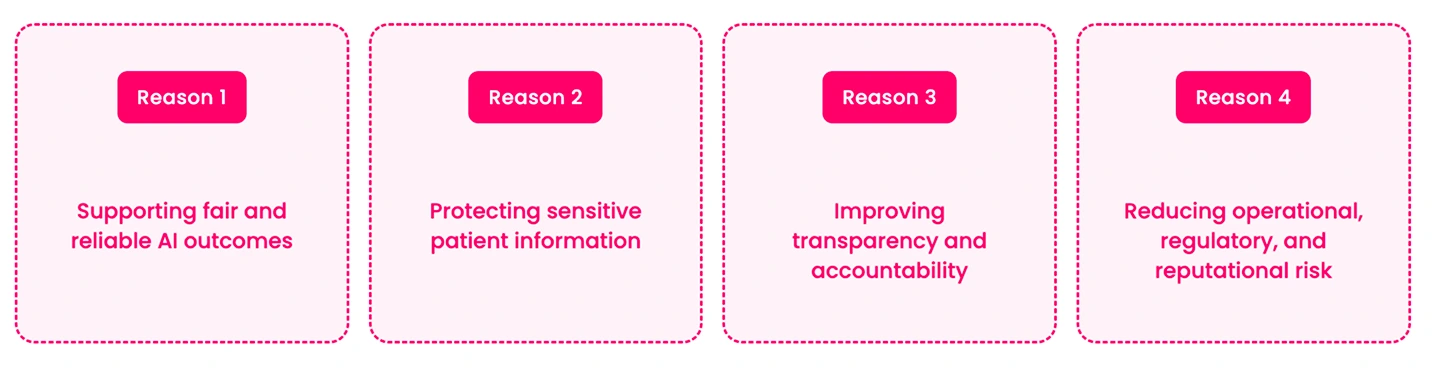
Supporting Fair and Reliable AI Outcomes
AI systems learn from historical data, which means they can also inherit historical biases. If training datasets are incomplete or unrepresentative, models may perform inconsistently across patient populations and contribute to disparities in care. Governance helps organizations establish standards for data quality, representativeness, and validation, reducing the risk of unintended bias and improving the reliability of AI-driven decisions.
Protecting Sensitive Patient Information
Healthcare organizations manage some of the most sensitive data in any industry. AI initiatives often require access to large volumes of clinical, operational, and patient information, increasing the importance of strong security and privacy controls. Effective governance helps ensure that data is accessed appropriately, protected throughout its lifecycle, and managed in accordance with regulations such as HIPAA and GDPR.
Improving Transparency and Accountability
Trust in healthcare AI depends on the ability to understand how data is used and how decisions are made. Governance frameworks establish clear processes for documenting data sources, monitoring model performance, and maintaining audit trails. This transparency allows organizations to investigate issues, demonstrate compliance, and provide greater confidence in AI-supported recommendations.
Reducing Operational, Regulatory, and Reputational Risk
As healthcare organizations scale AI adoption, governance becomes an important mechanism for managing risk. Clear policies for data management, model validation, and ongoing monitoring help reduce the likelihood of compliance violations, inaccurate predictions, and unexpected model behavior. Strong governance practices also make it easier to adapt to evolving regulatory requirements and maintain stakeholder trust over time.
Healthcare Data Governance Challenges and AI Risks
Building an AI data governance framework is relatively straightforward on paper. Scaling it across a healthcare organization that manages thousands of users, multiple clinical systems, growing data volumes, and evolving regulatory requirements is far more challenging.
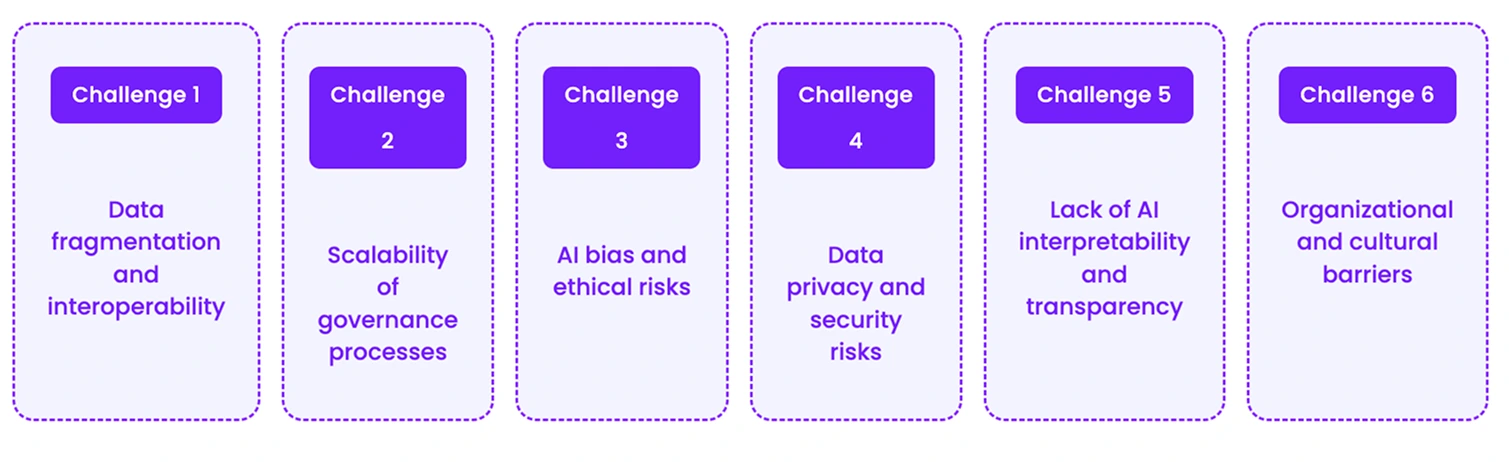
Data Fragmentation and Interoperability
One of the most significant barriers to effective AI governance is fragmented healthcare data. Patient information is rarely stored in a single system. Instead, it is distributed across electronic health records (EHRs), laboratory information systems, imaging platforms, billing applications, patient portals, wearable devices, and third-party solutions.
These systems often use different standards, data models, and terminologies, creating inconsistencies that make data integration difficult. Even when organizations adopt interoperability standards such as FHIR, challenges remain around data quality, completeness, and semantic consistency.
For AI initiatives, fragmented data creates significant risks. Models trained on incomplete patient histories may generate inaccurate predictions, while inconsistent coding practices can introduce bias and reduce model reliability. Effective governance must therefore include clear standards for data integration, normalization, metadata management, and interoperability across the healthcare ecosystem.
Scalability of Governance Processes
Many healthcare organizations begin their governance journey with manual reviews, spreadsheet-based controls, and small governance committees. While these approaches may work for limited analytics projects, they become increasingly difficult to maintain as organizations scale AI initiatives across departments and facilities.
Modern healthcare environments generate vast amounts of structured and unstructured data from clinical records, medical imaging, genomics, remote monitoring devices, and digital health applications. Governance processes must evolve to handle this complexity without creating operational bottlenecks.
Organizations increasingly rely on automation, cloud-native platforms, and metadata-driven governance solutions to support real-time policy enforcement, automated lineage tracking, and continuous monitoring. Without scalable governance capabilities, organizations often struggle to maintain consistency as AI adoption expands.
AI Bias and Ethical Risks
Bias remains one of the most widely discussed challenges in healthcare AI. Machine learning models learn from historical data, which may reflect existing inequalities in healthcare access, treatment patterns, or patient outcomes. If these biases are not identified and addressed, AI systems can unintentionally reinforce disparities rather than reduce them.
The challenge extends beyond technical performance. Healthcare organizations must also consider ethical questions surrounding fairness, accountability, informed consent, and transparency. Stakeholders increasingly expect organizations to demonstrate not only that AI systems work, but that they work equitably across diverse patient populations.
Strong governance frameworks establish mechanisms for evaluating dataset representativeness, testing model fairness, documenting ethical considerations, and continuously monitoring outcomes after deployment. These practices help organizations move beyond compliance and build AI systems that clinicians and patients can trust.
Data Privacy and Security Risks
Healthcare data remains one of the most valuable and sensitive categories of information. As organizations expand their use of AI, they also increase the number of systems, users, and workflows that interact with protected health information.
Traditional cybersecurity challenges are now compounded by AI-specific risks. Sensitive information may be exposed through training datasets, model outputs, prompts, or third-party AI services. Organizations must also consider emerging threats such as model inversion attacks, prompt injection attacks, and unauthorized extraction of training data.
Effective governance requires a comprehensive approach that combines technical safeguards, access controls, encryption, monitoring, privacy-preserving techniques, and well-defined policies governing how AI systems can access and process healthcare data.
Lack of AI Interpretability and Transparency
Many advanced AI systems deliver impressive predictive performance but provide limited insight into how decisions are made. This lack of transparency can create significant challenges in healthcare environments where clinicians are expected to justify treatment decisions and regulators increasingly demand explainability.
Without sufficient visibility into model behavior, organizations may struggle to identify errors, investigate unexpected outcomes, or demonstrate compliance during audits. Clinicians may also be reluctant to adopt systems they do not fully understand or trust.
Governance frameworks should establish requirements for model documentation, explainability techniques, performance reporting, and human oversight. Explainable AI approaches such as SHAP, LIME, and model monitoring tools can help organizations improve transparency while maintaining model effectiveness.
Continuous Validation and Model Monitoring
AI systems evolve over time as data patterns change. Patient populations shift, clinical practices evolve, and new treatments emerge. As a result, models that perform well today may become less accurate in the future.
This phenomenon, commonly known as model drift, creates significant governance challenges. Organizations must continuously evaluate model performance. Continuous validation requires dedicated governance processes, skilled personnel, and specialized monitoring infrastructure. While these activities can be resource-intensive, they are essential for maintaining trust, regulatory compliance, and patient safety over the long term.
Organizational and Cultural Barriers
Technology is only one part of the governance equation. Many healthcare organizations face challenges related to ownership, accountability, and organizational alignment. Governance initiatives often involve clinical teams, compliance officers, legal departments, IT teams, data engineers, and executive leadership—each with different priorities and perspectives.
Without executive sponsorship and cross-functional collaboration, governance programs frequently struggle to gain traction. Organizations may develop policies that look comprehensive on paper but fail to influence day-to-day practices.
Successful healthcare organizations treat governance as an ongoing organizational capability rather than a one-time compliance initiative. Building a governance culture requires clear leadership, education, communication, and accountability mechanisms that encourage responsible data usage across the enterprise.
Best Practices for Data Governance in Healthcare
Overcoming these challenges requires a deliberate and structured approach. The following best practices can help healthcare organizations strengthen their AI data governance capabilities.
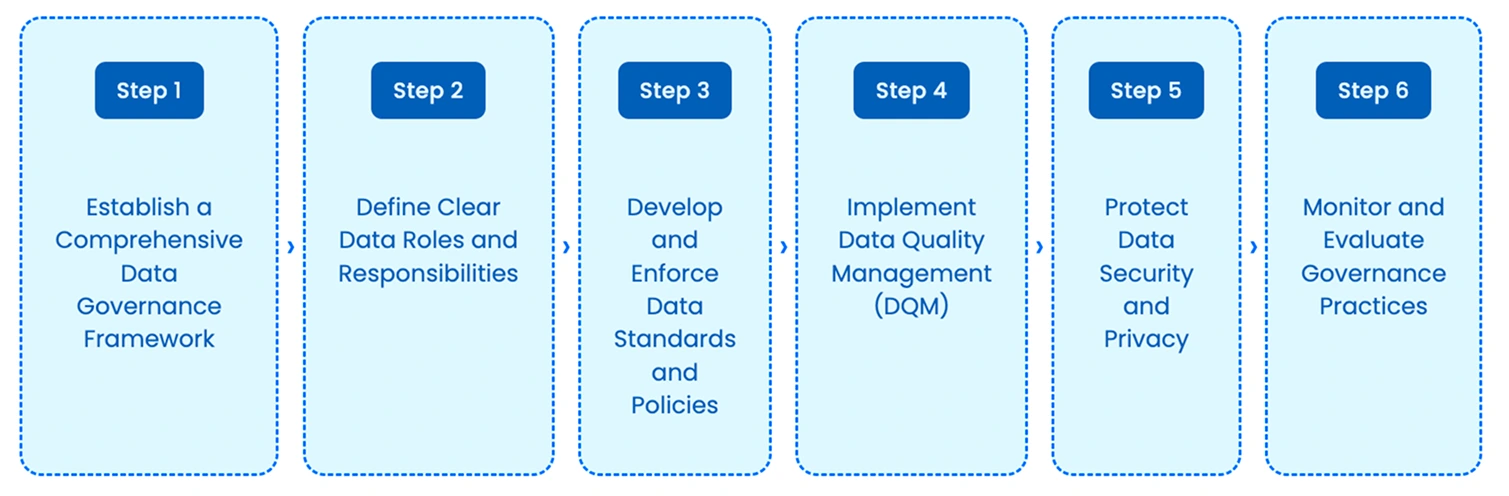
Establish a Comprehensive Data Governance Framework
A governance framework sets the rules for data handling across your organization. It must define the entire data lifecycle from creation to retirement, and align policies with HIPAA, GDPR, and other regulations. Involve IT, compliance, clinical, and legal teams to ensure the framework is both robust and operationally practical.
To make the framework operational, teams need to:
- Identify data domains (e.g., clinical, billing, research).
- Define rules for each domain (access, quality, retention).
- Align policies with HIPAA, GDPR, and local health data laws.
- Use tools like Unity Catalog to enforce access and track usage.
Define Clear Data Roles and Responsibilities
Role clarity is critical in any governance program. When it’s unclear who owns what data, who ensures its accuracy, and who has access to it, organizations quickly encounter compliance and performance issues. Assigning clear roles, such as data owner, data steward, and data user, reduces confusion and sets expectations for how data is handled throughout its lifecycle.
Develop and Enforce Data Standards and Policies
Data standardization improves consistency, interoperability, and reliability across departments. In healthcare, this means using consistent medical coding (like ICD-10 or SNOMED CT), defining field formats (like date of birth or lab values), and enforcing naming conventions for files and reports.
Policies should address questions such as:
- How is data collected and validated?
- Who can access or modify each data type?
- How long should they be retained before deletion?
- What are the rules for third-party data sharing and vendor integration?
Governance teams should regularly audit systems to identify gaps and refine enforcement strategies. Without real follow-through, even well-written standards fail to deliver impact.
Implement Data Quality Management (DQM)
High-quality data is non-negotiable in healthcare, especially when used to power AI models or clinical decision tools. Inaccurate, incomplete, or outdated data can lead to wrong diagnoses, compliance issues, or biased predictions. An effective DQM program should include data profiling to find issues, data cleansing to fix them, and data matching to merge duplicates.
Protect Data Security and Privacy
Protecting patient data is a core governance duty. Implement technical safeguards like data encryption and role-based access controls as your first line of defense. But technology is not enough. Train all staff to recognize phishing attempts, follow data-handling policies, and report suspicious activity immediately.
Monitor and Evaluate Governance Practices
A governance program must be continuously monitored to stay effective. Governance teams should review policy compliance, AI system behavior, and user access patterns to identify emerging risks or bottlenecks that may arise. This ongoing evaluation ensures that governance frameworks evolve with the organization’s needs.
Building a robust data governance strategy requires the right technology partner. KMS Technology works with providers, payers, and life science organizations to modernize their data infrastructure, improve data integrity, and operationalize analytics across teams. Our experts help you lay the groundwork for responsible AI by ensuring your data is secure, compliant, and ready to drive clinical and operational outcomes.
Healthcare Data Governance Services and Solutions for AI Adoption
Many organizations rely on healthcare data governance services to accelerate framework implementation, improve compliance, and establish scalable governance processes across clinical and operational systems. KMS Technology helps organizations establish the data pipelines, quality controls, and governance frameworks needed to power responsible, high-impact AI.
- A healthcare-specialized team to modernize and govern your clinical, operational, and financial data.
- Proven experience supporting AI projects, predictive analytics, and regulatory reporting.
- Support for both short-term data cleanup and long-term AI scalability.
Whether you’re launching a new AI initiative or improving your existing data foundation, KMS Technology delivers the clarity, speed, and compliance you need to move forward with confidence. Contact us today to jumpstart your AI solution.
This article was originally published on Nov 25, 2025, and was recently updated to add new sections: key insights, FAQ, why is data governance important, and a specialist’s inputs.