

Software development is shifting toward a new model in which engineers define outcomes and guide AI agents through prompting. As agents handle more coding, engineers must put their focus on the requirements, architecture, and validation needed to meet business goals.
Systematically, AI has progressed from autocomplete and inline suggestions to conversational code generation and agents that execute and test changes across a codebase. The figure below shows this evolution toward greater autonomy.
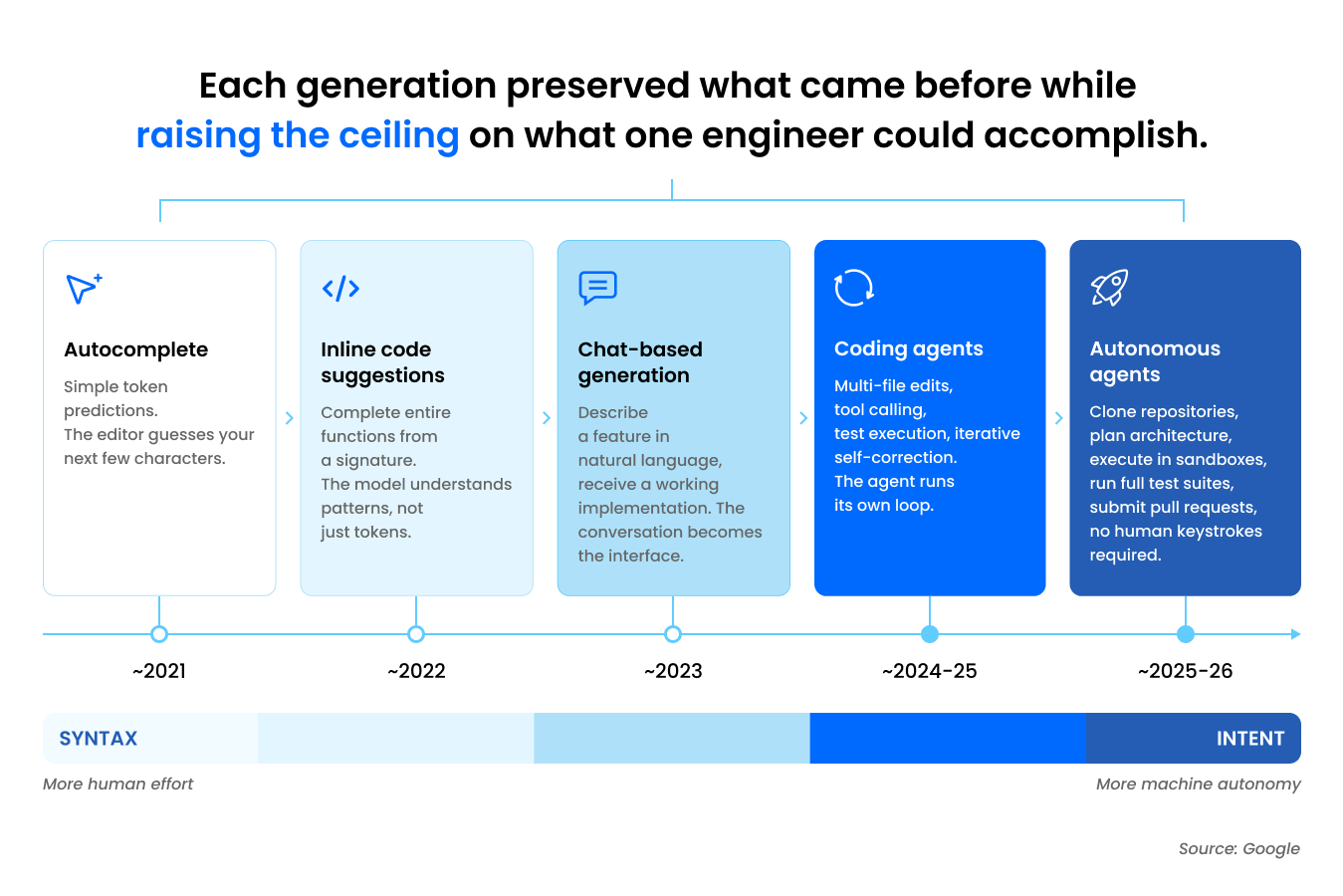
Moving from vibe coding to agentic engineering means bringing that autonomy into a disciplined delivery process. Here’s what enterprise teams need to get right as agents take on more responsibility and faster implementation raises the stakes for delivery.
Key Takeaways:
- Vibe coding speeds up one developer inside a conversation, whereas agentic engineering delegates goal level tasks to agents and makes people the orchestrators.
- Faster code creates business value when teams can verify that software meets approved requirements and is ready for production.
- Spec-driven orchestration keeps approved requirements connected to implementation, testing, and release decisions as changes evolve.
- Agentic engineering still depends on testing and named human owners, since only a person can confirm that a specification reflects the business decision behind it.
- Start with one bounded workflow and measure delivery time, rework, quality, and total effort before expanding agent responsibilities.
What Is Agentic Engineering?
What Is Agentic Engineering?
Agentic engineering is the practice of developing software with AI agents that can use tools, write and execute code, and iterate on results under human direction.
Coding agents work by their ability to generate and execute code in a loop. Execution allows an agent to inspect results and adjust its work without requiring a person to direct every individual action.
Human expertise remains central throughout. Engineers increasingly shape the conditions under which agents work, identify where their judgment is insufficient, and accept responsibility for the software produced.
Agentic Engineering vs Vibe Coding: What are The Differences?
Vibe coding describes a rapid cycle of prompting, observing output, and requesting adjustments, with limited attention to the underlying implementation. The approach can help someone explore an idea or build a disposable prototype.
Agentic engineering applies engineering discipline to work performed with AI agents. The team establishes expected behavior, controls how work proceeds, and evaluates implementation against evidence.
The same tool can support different practices. A coding agent used to produce an unexamined prototype serves a different purpose from one working within a reviewed implementation plan and a maintained testing process.
| Vibe coding | Agentic engineering | |
| Task definition | Prompts and feedback on the visible result. | Defined goals, requirements, system constraints, and engineering decisions. |
| Execution approach | The user requests adjustments as the result develops. | Agents execute bounded tasks, inspect results, and escalate defined problems. |
| Available context | Information supplied during the immediate interaction. | Relevant requirements, code, dependencies, documentation, and test history. |
| Validation approach | The output appears to satisfy the request. | Reviews and tests evaluate behavior against approved expectations. |
| Decision authority | Boundaries may remain implicit during exploration. | Permissions and approval responsibilities are established in advance. |
| Retained artifacts | Generated code and some conversational context. | Maintained code, decisions, tests, and evidence that support future changes. |
Moving toward agentic engineering requires deliberate choices about these practices. Adopting an agent capable of autonomous action creates the capability to do more work; the surrounding workflow determines how reliably that capability is used.
Why Faster Code Leaves Delivery Work Unfinished
30%
of technology professionals trust AI generated output only a little or not at all.
Source: Dora
Software delivery includes substantial work beyond implementation. Teams clarify business rules, assess dependencies, evaluate technical options, test interactions, and prepare systems for release.
Accelerating code generation can expose constraints elsewhere. Reviewers may receive more changes than they can assess. Quality engineers may struggle to validate an expanding volume of output. Product owners may discover that an unresolved assumption has already spread into code and tests.
For leaders, a reasonable implication is to assess AI across the complete path to an accepted business change. Reduced coding time matters alongside review effort, testing delays, rework, and production outcomes.
Agentic engineering should therefore be evaluated through the work the organization can complete confidently. More generated code has limited business value when the team cannot establish whether that code implements the intended change.
The Practices Behind Reliable Agentic Engineering
Reliable agentic AI software development depends on several connected practices. Each addresses a different question: what the agent should accomplish, what it needs to know, how it may act, and what evidence supports accepting its work.
1. Clear Intent and Testable Requirements
Agents need a sufficiently precise definition of the problem they are expected to solve. Business rules, important exceptions, constraints, and acceptance criteria give implementation and review a shared reference.
Spec-driven development supports that requirement by making intended behavior explicit. A living specification can preserve decisions as work moves between business analysts, developers, quality engineers, and AI tools.
KMS’s perspective on spec-driven development, featuring Phong Bui – our SVP of Technology on AI & Innovation, emphasizes clearer requirements and stronger business analysis and testing capabilities as teams adopt AI-native engineering.
Within agentic engineering, specifications provide one important source of direction. Their value depends on whether teams review their meaning, maintain them as requirements evolve, and use them to evaluate delivered behavior.
2. Relevant and Maintained System Context
A clearly written task can still produce a poor change when the agent lacks information about the existing system.
The agent may need to understand current interfaces, architectural constraints, dependencies, and established testing practices. Missing context can lead to duplicated functionality or changes that satisfy an isolated request while disrupting another workflow.
Teams should make approved information accessible while keeping it relevant to the task. Supplying an entire document collection can increase the burden of finding the few details that govern the change.
3. Deliberate Orchestration
AI agent orchestration determines how work moves between agents, tools, automation, and people. A useful workflow defines the task, the information required to perform it, the checks applied to its output, and the conditions that require intervention.
Some activities follow predictable steps. Others benefit from an agent choosing its next action based on what it discovers. Anthropic distinguishes between predefined workflows and agents that dynamically direct their tool use, recommending that teams match the approach to the problem.
Orchestration becomes useful when those transitions are explicit enough to inspect and maintain.
4. Validation at Two Levels
Teams need to evaluate both the software produced and the agent workflow producing it.
Software testing examines behavior: whether business rules are implemented correctly, integrations work, and relevant security or performance expectations are met. Evaluating the agent workflow examines whether the agent uses appropriate sources, respects its permissions, recognizes uncertainty, and completes tasks consistently.
Those questions require different evidence. A feature can pass its functional tests while the agent takes an unauthorized action during implementation. An agent can follow its instructions carefully while producing software based on an incorrect requirement.
Evaluation should therefore include representative tasks and failure conditions. Teams need to know how the workflow behaves when requirements conflict, tools fail, or available context is insufficient.
5. Explicit Human Authority
Agent autonomy needs a defined scope. The ability to inspect a repository, modify a development branch, or execute tests involves different consequences from changing production data or authorizing a release.
Teams should establish which actions agents may perform, which require approval, and which remain outside their responsibilities. Cost limits, retry limits, and stopping conditions belong within that design.
Several responsibilities may sit with the same person on a smaller team. The essential requirement is that consequential decisions have identifiable owners.
What Spec-Driven Orchestration Looks Like in Practice
Spec-driven orchestration brings the above-mentioned agentic engineering practices together around the approved specification. The requirements established through spec-driven engineering remain connected to each task, handoff, and validation step as people and agents deliver the change.
Consider a request to allow refunds on eligible purchases within 30 calendar days. The workflow would proceed as follows:
1. Agree on behavior: The product owner and quality engineers clarify eligibility, exclusions, and boundary conditions before implementation begins. The reviewed specification records those decisions, acceptance criteria, and who can approve changes.
2. Coordinate the work: Implementation tasks and test scenarios reference the approved specification version, with relevant code and system constraints supplied as context. Engineers review the proposed approach, agents perform permitted implementation tasks, and quality engineers establish expected results from the approved business rule.
3. Verify the change: Testing evaluates the implementation against the specification, including purchases at and beyond the eligibility boundary. The workflow brings the tested build, linked results, and unresolved issues to the release owner for a decision.
4. Keep changes aligned: When the refund rule changes, the workflow routes the revised specification and affected tasks back to the appropriate owners. Relevant code and tests are updated, required checks rerun, and affected approvals reviewed before release.
The practical value is traceability: teams can connect what the business approved, what people and agents built, and what testing verified.
Orchestration With VELOX
VELOX is KMS Technology’s AI delivery accelerator designed to support agent orchestration across the software development lifecycle. The platform helps connect AI agents, delivery tools, and project knowledge using shared context, including requirements and code history.
Within agentic engineering, VELOX helps coordinate implementation and testing around approved requirements, while humans guide the work and make critical delivery decisions.
Explore how VELOX connects your teams, agents, and tools →
Why Quality Engineering Remains Central
An agent’s ability to run tests creates a useful feedback mechanism. The strength of that mechanism depends on the tests, their expected outcomes, and the conditions under which they run.
Generated code and generated tests can share the same mistaken assumption. A refund implementation and its tests could both apply the wrong eligibility window, producing passing results without satisfying the approved business rule.
Anthropic’s experiments with long-running coding agents illustrate another limitation. Agents sometimes marked features as complete after code changes and limited checks while missing failures in the complete user workflow. Explicit instructions and browser based verification helped expose problems that were not apparent from code alone.
Quality engineering provides the discipline to challenge those gaps. Domain expertise, independently reviewed expectations, integration testing, and exploratory testing help establish whether the software behaves appropriately beyond the agent’s immediate task.
Case Study: KMS x iPipeline
iPipeline, a provider of digital solutions for life insurance and financial services serving more than 100 carriers, partnered with KMS to rebuild its quality engineering into an automation first, AI driven model.
- 75% maximum reported reduction in testing cycle time.
- 90–95% automation coverage.
- 60% reduction in production defect leakage.
- 2,500+ critical test cases automated.
The engagement addressed extensive manual testing, lengthy regression cycles, and increasing product complexity. KMS introduced automation and AI supported testing capabilities, prioritized valuable scenarios, and embedded automation and reporting into the delivery pipeline.
For enterprises expanding the work performed by agents, the practical lesson is to develop validation capacity alongside implementation capacity.
Read the full iPipeline case study →
Where Agentic Engineering Needs Restraint
Greater autonomy introduces additional decisions about complexity, review effort, and control. Teams should expand agent responsibilities where the evidence supports doing so.
1. More Agents Can Add Coordination Work
Every additional agent introduces information to transfer, outputs to assess, and failures to handle. A workflow can become harder to debug as responsibility spreads across more participants.
Anthropic recommends beginning with the simplest solution that meets the task and increasing complexity when needed. Its guidance recognizes that agentic systems can trade cost and latency for improved task performance.
Additional agents should address an observed limitation. A clear task, reliable tools, and an established test suite may provide sufficient support for a single agent.
2. Documentation Can Become a Maintenance Burden
Specifications, instructions, and execution records need to remain useful to the people responsible for delivery. Excessive generated documentation can consume review capacity while obscuring important decisions.
Teams should retain information that explains behavior, constraints, accepted tradeoffs, and evidence. Repeated summaries and artifacts with no clear owner or use should be candidates for removal.
3. Agreement Between Models Can Conceal Shared Errors
A second model does not automatically provide independent assurance. Agents working from the same incomplete requirement can reinforce the same incorrect conclusion.
Teams should introduce evidence capable of challenging the proposed change. Approved business examples, domain review, deterministic checks, and realistic integration results provide different ways to expose weaknesses.
Autonomy should expand according to task specific performance. Success with one class of change provides a basis for evaluating the next responsibility, with its own permissions and acceptance conditions.
How to Begin With an Existing Engineering Team
Start with one recurring workflow within your existing delivery process. A bounded scope makes the benefits, failures, and overhead easier to assess before expanding.
1. Define the problem: Choose a delivery problem with clear boundaries and measurable consequences. Establish a baseline and a target, such as reducing rework or shortening the time from an approved requirement to a validated release.
2. Establish context, ownership, and permissions: Give agents access to approved requirements, relevant system information, and the tools needed for the task. Assign owners for key decisions and define permitted actions, approval points, and escalation conditions.
3. Evaluate the results: Test representative changes, including cases involving ambiguity, failed checks, and revised requirements. Measure delivery time, human review, agent costs, and software quality to understand the complete impact.
4. Expand through demonstrated performance: Increase agent responsibilities when repeated results show reliable performance with manageable overhead. Confirm that the workflow keeps requirements, code, and tests aligned as changes occur.
KMS Technology’s AI-native product engineering approach connects specification led engineering, coordinated agent workflows, and production feedback. Engineering expertise and quality validation help teams turn faster implementation into reliable delivery while retaining human accountability for what reaches production.
Bottom Lines
AI agents give engineering teams greater capacity to investigate, implement, test, and iterate. Enterprise value depends on how effectively that capacity translates into software the organization can understand, validate, and maintain.
As AI agents take on more implementation, engineering judgment becomes more consequential. Moving from vibe coding to agentic engineering depends on three connected principles:
- Clear direction: Give agents approved requirements and architectural standards that keep implementation aligned with business needs.
- Rigorous validation: Test and review outputs against expected behavior, including important exceptions and system dependencies.
- Human accountability: Keep engineers responsible for technical tradeoffs, release decisions, and the software delivered.
Remember that faster code only creates business value when teams can confidently release it, operate it, and build on it.
