
The financial sector has always been a prime target for cyberattacks. With the rapid adoption of digital banking, mobile payments, and cloud-based services, the risks have multiplied—creating new vulnerabilities across systems, networks, and third-party integrations.
According to IBM’s Cost of a Data Breach Report 2025, the global average cost of a breach in the financial industry reached $5.56 million, ranking among the highest of any sector. As financial institutions digitize operations, their exposure to evolving threats such as ransomware, phishing, and API exploitation grows significantly.
In this high-stakes environment, penetration testing has become an essential cybersecurity practice. It simulates real-world attacks to identify security flaws before criminals can exploit them, helping financial institutions protect sensitive assets and maintain customer trust.
You need to know why penetration testing is critical for the BFSI industry, how it works, its main types, and the best practices for implementation.
Why Penetration Testing Is Essential for Financial Institutions
The financial ecosystem processes billions of digital transactions every day. Each exchange involves sensitive information like account details, payment credentials, and personal identification data, which companies must protect from unauthorized access.
Despite investing heavily in cybersecurity, many institutions still face breaches caused by misconfigurations, unpatched systems, or insider threats. Penetration testing addresses these issues by simulating sophisticated attack scenarios to expose hidden vulnerabilities and assess response readiness.
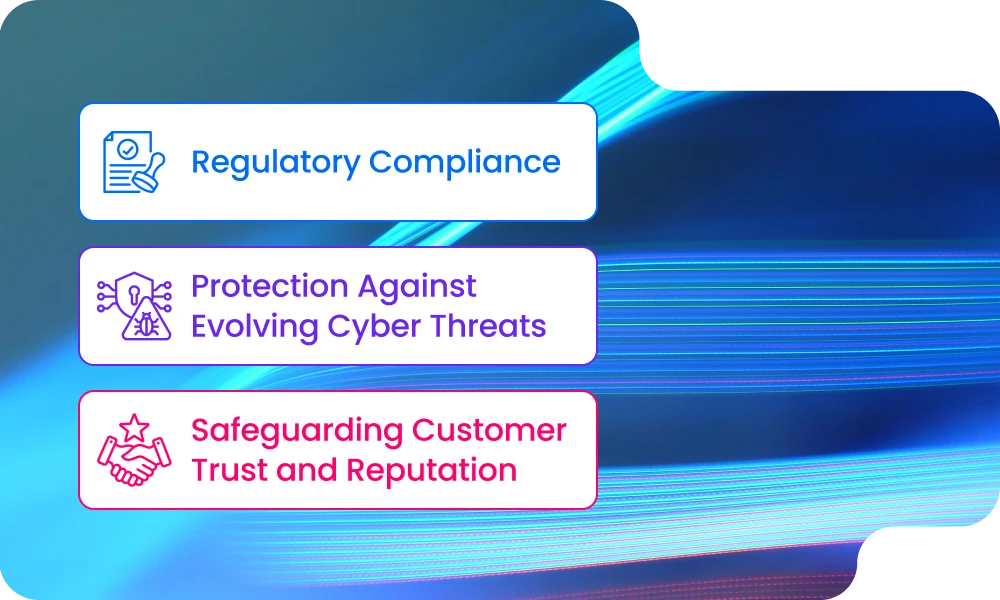
Regulatory Compliance
Financial institutions operate under strict regulations, including PCI DSS, ISO 27001, SOC 2, and NIST frameworks. Most of these require regular security testing to verify data protection measures.
Penetration testing demonstrates compliance by:
- Validating that security controls meet regulatory requirements
- Generating audit-ready reports for external assessors
- Reducing potential fines from noncompliance incidents
Protection Against Evolving Cyber Threats
Cybercriminals constantly adapt their tactics using phishing campaigns, malware injections, and zero-day exploits to compromise systems. Penetration testing helps institutions stay ahead of these threats by continuously identifying weak points and validating their defenses.
Regular testing ensures that emerging vulnerabilities in APIs, mobile apps, or cloud platforms are detected early and remediated promptly.
Safeguarding Customer Trust and Reputation
In finance, customer confidence is paramount. A single data breach can lead to severe financial loss, reputational damage, and customer churn. By proactively validating system security, financial institutions demonstrate accountability and resilience, key factors in retaining trust.
Penetration testing identifies risks to strengthen public assurance that the organization takes cybersecurity seriously.
How Penetration Testing Works
Penetration testing follows a structured process designed to emulate real-world attacks. Ethical hackers, known as pen testers, attempt to exploit vulnerabilities across networks, applications, and systems, using the same tools and techniques as malicious actors.
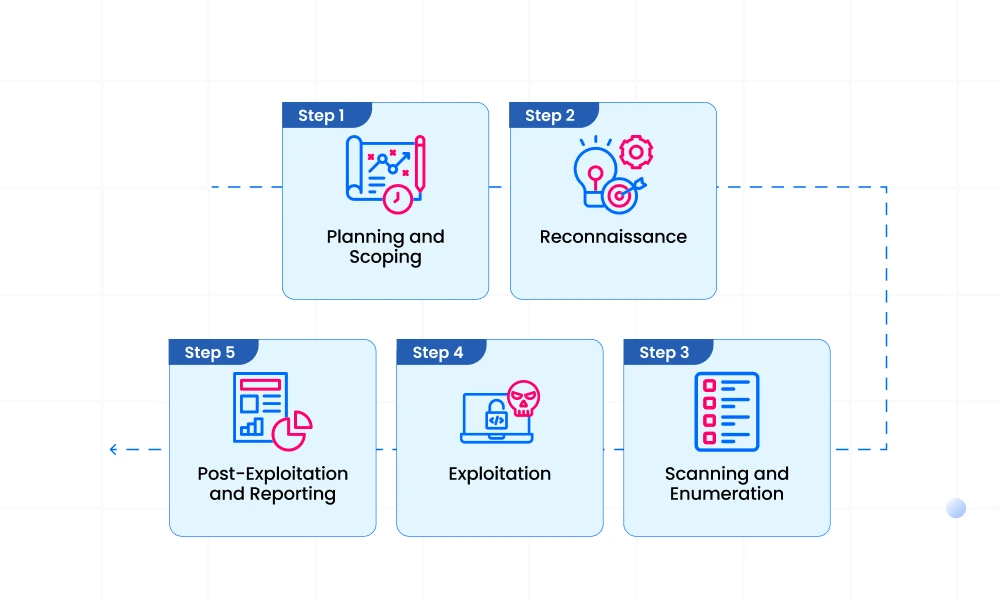
Step 1. Planning and Scoping
The process begins with defining objectives and scope. Teams identify which systems, applications, or environments to test — typically customer portals, APIs, and internal databases — to determine testing parameters, including authorization boundaries.
Step 2. Reconnaissance
In this phase, testers gather intelligence about the target environment, such as domain names, IP addresses, software versions, and open ports. This step mirrors how attackers identify entry points before launching an attack.
Step 3. Scanning and Enumeration
Automated tools scan the network for vulnerabilities like outdated software, weak configurations, or open ports. Enumerating these weaknesses provides a clear picture of potential attack surfaces.
Step 4. Exploitation
Pen testers attempt to exploit identified vulnerabilities to gain unauthorized access, escalate privileges, or extract data. This controlled process allows institutions to understand how real attackers might penetrate their systems.
Step 5. Post-Exploitation and Reporting
After testing, the team documents findings in a detailed report outlining:
- Vulnerabilities discovered and their severity
- Methods used for exploitation
- Potential impact on data and systems
- Recommended remediation actions
Finally, remediation and retesting ensure that vulnerabilities are fully resolved and the system’s defenses remain strong.
Transitioning from methodology to practical application, let’s examine the primary categories of penetration testing used in the financial sector.
Types of Penetration Testing in Finance
Penetration testing is platform-dependent. Different system architectures and business priorities require different types of testing to uncover distinct vulnerabilities.
Network Penetration Testing
Network testing evaluates the security of both internal and external infrastructures. Testers probe firewalls, routers, and servers for misconfigurations, unpatched systems, and weak authentication protocols.
For financial institutions managing online transactions, this type of testing ensures that customer data remains encrypted and network traffic is segmented correctly.
Web Application Penetration Testing
Web-based banking portals, trading platforms, and payment gateways are prime targets for attackers. Web application testing identifies vulnerabilities such as:
- SQL injection
- Cross-site scripting (XSS)
- Insecure direct object references (IDOR)
- Broken authentication and session management
This testing follows the OWASP Top 10 security framework to assess and mitigate the most critical risks.
Mobile Application Penetration Testing
Mobile apps have become the primary interface for digital banking. Their vulnerabilities were also the subject of several talks at the most recent DEFCON hacker conference. Testing evaluates the app’s architecture, APIs, and data storage methods to prevent threats such as reverse engineering, insecure encryption, or data leakage.
API Penetration Testing
APIs enable modern banking ecosystems, but they also expand the attack surface. Testing ensures that APIs follow best practices for authentication, authorization, and input validation, mitigating risks like token hijacking or mass assignment vulnerabilities.
Cloud Penetration Testing
As banks migrate to hybrid and multi-cloud environments, new security concerns arise. Cloud testing evaluates identity management, access policies, encryption, and storage configurations to prevent data exposure or unauthorized access.
Each of these testing types supports the others, creating a layered defense strategy for financial systems.
Key Benefits of Penetration Testing for Financial Institutions
Penetration testing delivers measurable value beyond simple risk identification. It strengthens both security and strategic decision-making.
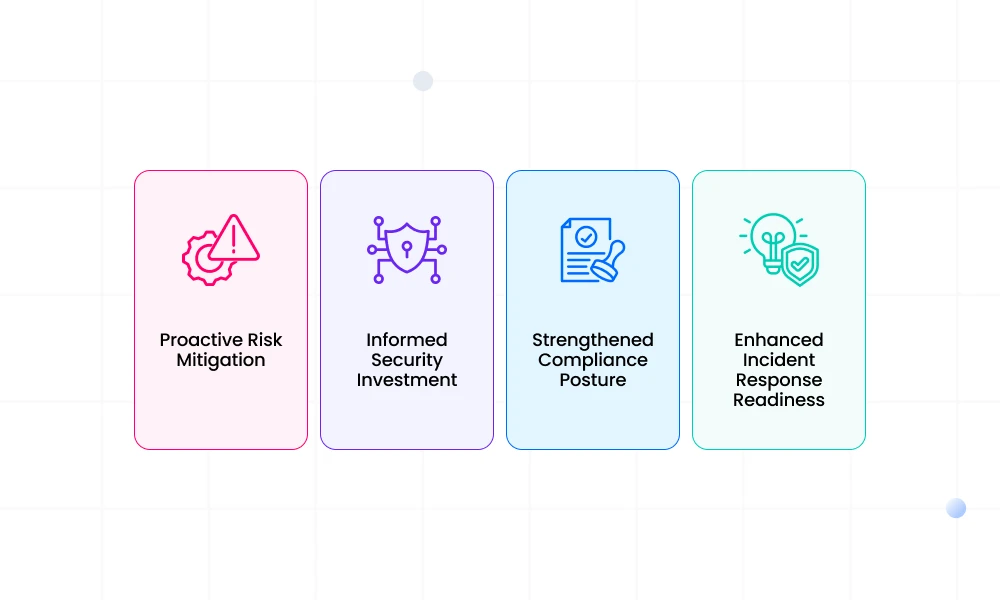
Proactive Risk Mitigation
Rather than waiting for an incident to occur, testing uncovers vulnerabilities before they can be exploited. Institutions can prioritize fixes based on severity, significantly reducing their risk profile.
Informed Security Investment
Comprehensive testing reports provide a clear roadmap for allocating cybersecurity budgets effectively. Firms must focus on high-risk areas to avoid unnecessary spending.
Strengthened Compliance Posture
Penetration testing helps maintain compliance with regulations like PCI DSS, SOC 2, ISO 27001, and GLBA. Demonstrating consistent testing also reassures auditors and regulators that proper safeguards are in place.
Enhanced Incident Response Readiness
Testing helps validate how well an organization can detect, respond to, and recover from attacks. It exposes gaps in response workflows and improves team coordination during real-world incidents.
By integrating pen testing into regular security programs, financial organizations build resilience against both known and emerging threats.
Challenges of Penetration Testing in the Financial Industry
Penetration testing in the BFSI sector faces several practical and operational challenges.
System Complexity
Challenge
Financial institutions operate diverse infrastructures—legacy systems, APIs, and third-party integrations. Coordinating testing across such complex environments can disrupt operations if not managed carefully.
Solution
Use controlled testing environments or staging platforms to minimize production impact. Adopting microservices-based testing also isolates vulnerabilities without halting critical systems.
Regulatory Constraints
Challenge
Penetration testing involves simulating cyberattacks, which can raise compliance concerns regarding data access and system exposure.
Solution
Ensure testing adheres to applicable laws and frameworks such as PCI DSS, GDPR, and local data privacy regulations. Partnering with certified testing providers ensures ethical standards and documentation are met.
Skill and Resource Gaps
Challenge
Effective testing requires specialized knowledge of attack methodologies and tools. Many in-house teams lack the expertise to conduct deep, end-to-end testing.
Solution
Collaborate with experienced cybersecurity firms that specialize in financial environments. External partners bring advanced tooling, up-to-date methodologies, and unbiased assessments.
By addressing these challenges proactively, financial institutions can execute pen testing efficiently and securely.
Best Practices for Effective Penetration Testing
To maximize the value of penetration testing, organizations should follow proven best practices grounded in industry standards.
- Conduct Testing Regularly: Schedule tests at least once or twice a year—or after major system updates or integrations.
- Adopt a Risk-Based Approach: Prioritize testing on systems with the highest data sensitivity and user exposure.
- Combine Manual and Automated Testing: Automation speeds up detection, while manual analysis validates findings and uncovers complex vulnerabilities.
- Leverage Established Frameworks: Use NIST, OWASP, and PCI DSS guidelines to maintain global best practices.
- Close the Loop with Retesting: After remediation, conduct follow-up tests to confirm vulnerabilities have been resolved effectively.
Embedding penetration testing into a broader cybersecurity strategy creates a culture of continuous improvement and vigilance.
Strengthen Financial Cybersecurity with KMS Technology
In a public-facing financial ecosystem, penetration testing is a business-critical defense measure. Regular testing empowers institutions to identify risks early, ensure compliance, and protect customer trust.
At KMS Technology, some of the world’s best ethical hackers specialize in delivering comprehensive penetration testing services tailored to the unique challenges of the financial sector. Our certified security experts conduct rigorous testing across networks, applications, APIs, and cloud environments—aligned with OWASP, NIST, and ISO standards.
We help financial organizations:
- Identify and Prioritize Vulnerabilities: Through detailed assessments and actionable remediation plans.
- Validate Security Controls: Ensuring systems remain compliant with global frameworks.
- Strengthen Threat Response Capabilities: By exposing weaknesses before they can be exploited.
We help organizations fortify their financial cybersecurity posture and build resilience against evolving threats.
Ready to strengthen your digital defenses? Contact KMS Technology today to learn how your company can better defend against loss and downtime.