
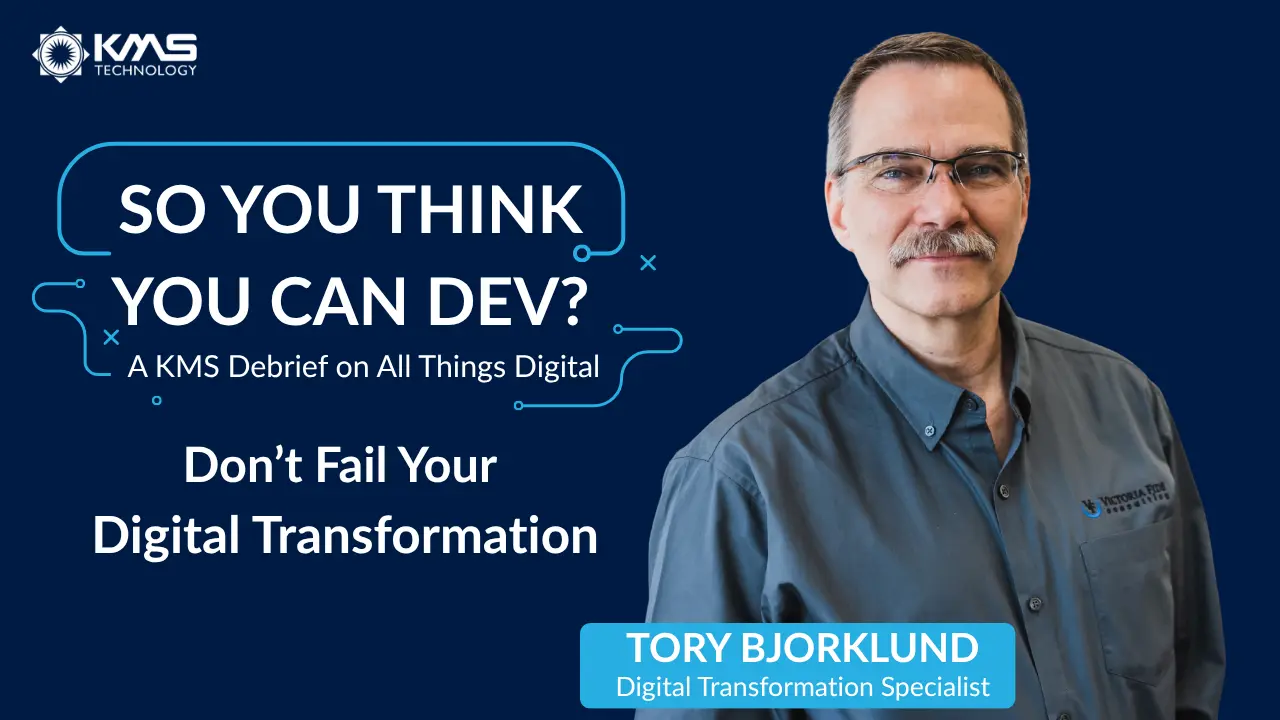
Despite dramatic leaps in technology, digital transformation projects are still failing at alarming rates. They exceed their scope, drag on for months or even years, and shuffle through departments, becoming more and more convoluted.
Why?
Most organizations approach their digital transformation strategy from the wrong angle. That’s why we talked with Digital Transformation Specialist, Tory Bjorklund, on the latest episode of So You Think You Can Dev?
Listen to the episode here, or read our recap and analysis below.
What is Digital Transformation in 2026?
To achieve a successful digital transformation, organizations must think beyond the buzzwords and market pressures. The worst thing a team can do is pour time, money, and energy into an initiative that’s launched to a resounding “who cares?”
To be transformative, it has to actually change the way you’re doing business.Tory Bjorklund | Digital Transformation Specialist
Consider apps for fast food restaurants and mobile delivery services. Consider the Netflix vs Blockbuster paradigm shift or the way Amazon changed shipping.
“That was done through digital technology. It transformed our expectations. I never would have thought to ask to get products overnight…but once it became available in one place, now we expect it to be everywhere.”
Not every company can create a culture shift to this degree. But a great digital transformation strategy asks the question: How can we raise the bar for our customers, and change their expectations for the better?
Customers, after all, are key to every digital transformation strategy. If you’re not engaging your customers or end users, it’s not meaningful transformation.
5 Reasons Your Digital Transformation Strategy Fails (and How to Fix It!)
Let’s talk about the pitfalls to avoid in your digital transformation initiatives, so you can better adapt your business models.
1. Better Digital Technologies, Same People Problems
From AI-assisted code reviews to advanced integration architectures, digital technology continues to leap forward.
Despite these massive advances, the failure rate for digital transformation initiatives is getting worse.
So what gives? If the tools are better, why aren’t the outcomes?
Much of the issue, according to Bjorklund, lies not in the tools, but in the people.
“The technology is improving. People aren’t.”
While agile methodologies and APIs have transformed the way teams write and integrate software, they haven’t resolved the deeper challenges of shifting business culture or leadership alignment. As Bjorklund puts it,
We have gotten a lot better at executing code. What hasn’t gotten any better is the planning, preparation, and leadership.Tory Bjorklund | Digital Transformation Specialist
This disconnect leads to endless requirement changes, a lack of vision, and project volatility — even as the technical execution improves.
Your digital solutions are the how. You may know the exact limitations of your legacy systems and the tools necessary to modernize. But remember that we’re talking about transformation, not just change. Start with a shared understanding between people. When you’re planning and preparing for a digital transformation, present a clear vision to leadership to build trust. Avoid the weeds of the how, and focus on the overall picture of the digital experience.
2. Cultural Change Evades the Top
A successful digital transformation strategy hinges on buy-in and stability from leadership.
If they aren’t convinced that this technology is actually going to do what they are intending for it, they won’t stand behind it for very long.Tory Bjorklund | Digital Transformation Specialist
Vision clarity and continuity are crucial. Without a well-defined and stable business objective, technology teams are left aiming at moving targets. It’s a recipe for missed deadlines and half-built solutions.
Remember that digital transformation is transformative. That means your team, from the top down, must buy into the change. Often, the excitement of the initial vision wears off as leadership is pulled into different obligations while the backend work starts. Communication breaks down. Concerns are levied at the most inconvenient times.
A good digital transformation strategy accounts for cultural change, which starts internally. Help your leadership team change the culture of your organization in favor of your digital transformation journey. And a journey, it is. Keep your evangelists engaged with regular updates and built-in feedback loops. Let them push the message through the organization and demonstrate their belief in the project.
3. Your Business Strategy Isn’t Aligned
The business and tech strategies must be aligned to support realistic deployment timelines and maintain momentum in the broader culture of your business.
For tech leaders, part of the job is helping the business side understand the complexity and constraints of software delivery. For Bjorklund, this comes down to “managing up” and clarifying expectations upfront.
A quick prototype may look like a near-finished product to the untrained eye of your business leaders, but that perception gap can derail timelines and create unrealistic expectations:
“We sometimes don’t do ourselves very good when we build a clickable prototype in a week and a half. Business leaders think, geez, you’re 80% there. Let’s get this thing done. And it’s like, no, we’re 2% there.”
Development timelines should be clearly laid out with built-in padding for inevitable derailments.
Technology leaders must actively push back against scope creep and unrealistic timelines with clear, succinct explanations. The more technology leaders can help connect the dots with larger business goals, in language the business side understands, the better. That means keeping the “why” at front and center. What value does this digital transformation create? How does the proposed roadmap support that larger goal?
Whether it’s ensuring critical scalability (more end users = more revenue opportunities) or allocating sufficient resources for testing (leakage = churn and revenue loss), keep your audience in mind.
Leadership perception can bring a digital transformation journey to a screeching halt faster than any bug or technical challenge. Set yourself up for success by controlling alignment where you can.
4. Misunderstanding the Demand Behind Digital Innovation
While the term “digital transformation” has become a buzzword, the demand behind it is real. But it’s not always driven by customer requests; it’s often driven by unmet needs.
Bjorklund points to COVID as an example of changing customer demands. The need for no-contact food service as well as the challenges of staffing these positions led to problems for customers: long wait times, food quality issues, and lack of accessibility. An urgent demand for contactless food service drove innovations in digital ordering and delivery, which has manifested in branching applications of this initial innovation.
Now, mobile ordering apps are par for the course. Customers were not specifically asking for the ability to order ahead. They simply had pains and frustrations that could be solved via digital solutions.
As such, the demand for digital innovation is not de facto. Organizations need to understand their customers’ friction and pain. Solving their problems is the unlock that shifts customer behavior and leads to further demand.
New features for the sake of competition are more likely to frustrate your customers than empower them, especially if the transformation interferes with their expectations. Customers want what works, not which buzzword looks best in the market. Always consider who your digital transformation is serving.
Which brings us to the biggest buzzword of today’s digital transformation initiatives.
5. AI is an Accelerator in Your Digital Transformation Journey (with Limits)
AI has changed the game for development speed and scalability. Tools like generative AI are already streamlining tasks like code reviews and data queries. But their utility hinges on a foundation that many organizations still lack: clean, structured, reliable data.
If you actually want to use AI in useful ways, particularly in an ongoing use case, your data is going to need to be standardized. It’s going to need to be clean. It’s going to need to be real.Tory Bjorklund | Digital Transformation Specialist
Bjorklund further describes AI as the “smartest two-year-old in the world.” Its understanding is limited to its data, and its application is limited to the organization’s understanding of its own processes.
Organizations that are leaning wholeheartedly on AI without considering the foundational work can undermine their digital transformation in several ways. Security risks, hallucinations, and non-repeatable workflows are all potential issues. Further, haphazard deployment of AI features in products can also cause unintended consequences.
Keep in mind what enhances customer experience and what impedes it. Is AI replacing critical functions or features? Is it intrusive? How does it help customers solve their problems, or is it simply added to the roadmap to appease market trends?
Until organizations invest in aligning and standardizing their data, AI’s value will remain limited — or at least heavily manual in setup. Likewise, AI features can create incredible value for your customers, but AI in and of itself is just technology. Successful digital transformations require a deeper understanding of customer expectations, not just a more advanced but misaligned solution.
The Next Frontier: Agentic AI and Orchestration for Digital Solutions
Beyond generative AI, Bjorklund sees agentic AI as the emerging wave in business transformation, and with it, the need for orchestration:
Take a diverse set of agents and orchestrate the exchange of data and information between them in a way that brings a meaningful outcome.Tory Bjorklund | Digital Transformation Specialist
Agentic AI differs from generative AI in that it can, in theory, operate autonomously with human supervision instead of intervention.
Right now, many teams are manually exchanging data and information, but there’s an opportunity for drag-and-drop tools and low-code platforms that simplify coordination across agents.
“We can orchestrate ETL-type work quite easily with graphical tools. Why can’t we do that with agentic development?”
These easy use cases are a good place to start with agentic AI, because a workflow is already clearly defined. And that’s key. Business processes must be wholly understood to replicate them effectively with agentic AI.
We are likely to see agentic AI as a driver of the upcoming digital transformation, but the winners will still be those who consider the bigger picture behind the technology and prioritize the right approach and alignment.
Let the Business Own It: Digital Experience as Customer Experience
Ultimately, digital transformation isn’t about the tech stack. It’s about the business goals, and those need to be set (and owned) by business leaders.
Bjorklund has a message for business leaders looking to achieve digital transformation success.
Digital transformation should not be driven by IT; the business needs to drive this. You need to own it. We’re a resource for you.Tory Bjorklund | Digital Transformation Specialist
When the business side sets a clear North Star and sticks with it, the tech side will thrive.
TAGS

Written by
Chief Delivery Officer
Jeff is a technology and delivery leader with more than 30 years of experience guiding software architecture, AI-native development, global teams, and strategic client engagements.