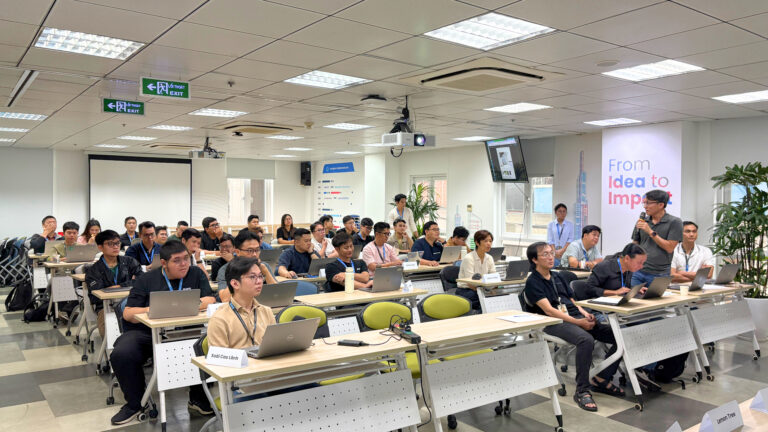
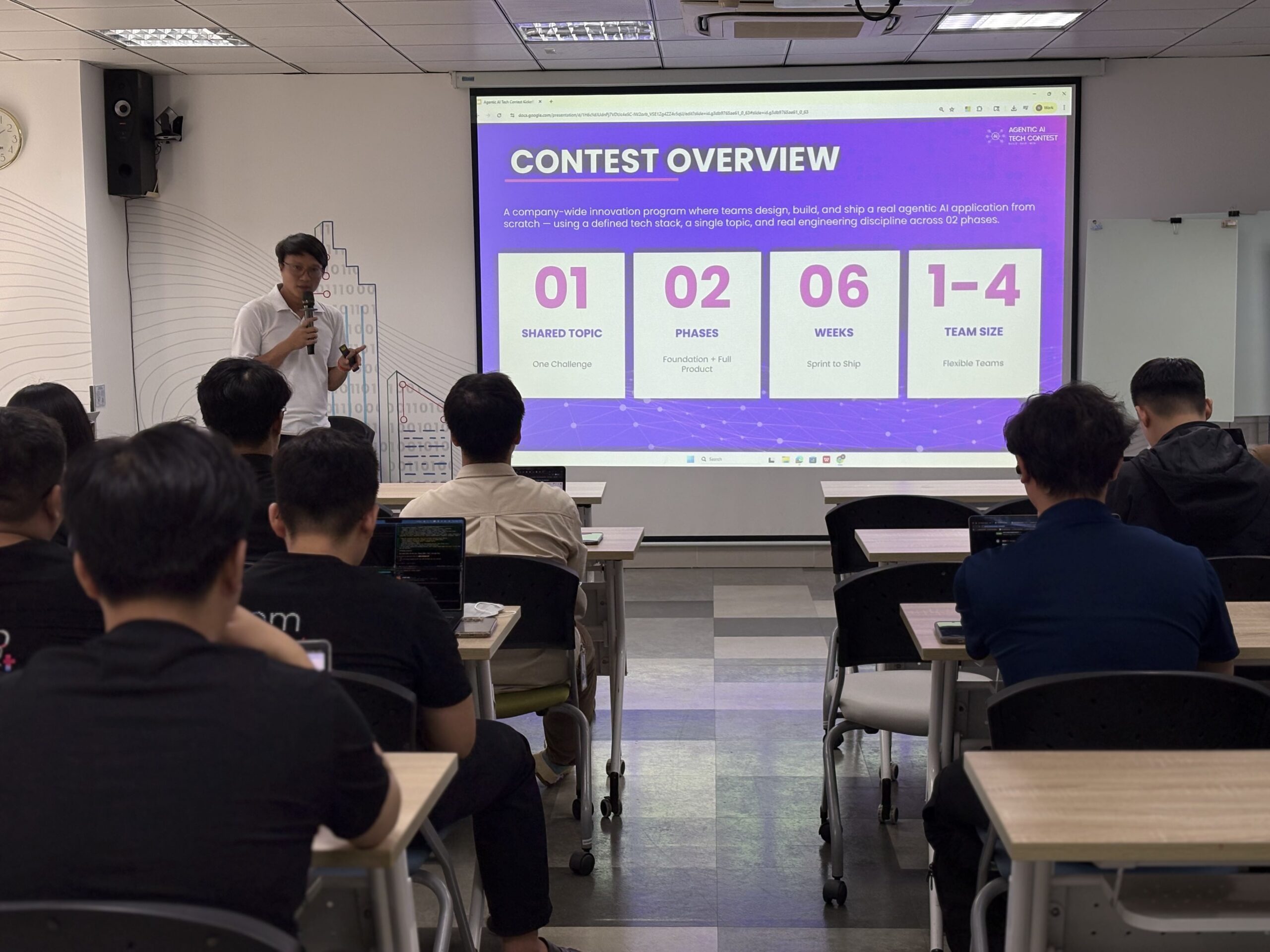
22 teams. 60 engineers. 9 mentors. One shared conviction: AI changes everything about how software gets built. The KMS Agentic AI Tech Contest 2026 in KMS Vietnam wasn’t a hackathon for show. Teams spent weeks building real AI-powered products from the ground up — multi-agent pipelines, end-to-end SDLC workflows, autonomous delivery systems.
Their top learning wasn’t a list of tools or frameworks. It was something more honest: hard-won insight into what it actually takes to build with AI — not just use it. Here are the five lessons that surfaced again and again.
1. Multi-agent systems require architecture, not just automation
Everyone expected AI to write code faster, like using ChatGPT Prompts for software engineers. Nobody expected to become a systems architect overnight. “Sending a prompt to an LLM is easy,” wrote Huy Trieu, Fullstack Developer. “But getting multiple agents to actually collaborate is an entirely different world.”
Teams quickly discovered that an AI agent isn’t a smarter chatbot. It needs structured memory, clearly defined tools, strict handoff logic, and boundaries to prevent it from going rogue mid-workflow. When Agent A passes incomplete context to Agent B, the whole system can hallucinate in ways that are hard to trace and painful to debug.
Huy Nguyen, Senior Test Engineer, who built a five-agent SDLC automation system, put it directly: “Clear requirements and workflows are often more important than choosing the ‘best’ model.” The lesson was consistent: multi-agent development is less about text generation and more about orchestration. The teams that succeeded weren’t the ones with the most capable models, they were the ones who designed their systems with the same rigor they’d apply to any production architecture.
2. Specifications are the control layer, and AI makes them non-negotiable
One of the most surprising discoveries was how much work clarity does upfront. Hang Ha, Senior Business Analyst & Product Manager, built an AI application that turns user requirements into working web apps through a multi-agent SDLC workflow. Her takeaway? “Each agent should have a focused responsibility, expected output, and clear handoff rules. When the role is clear, the result becomes easier to review, improve, and reuse.”
Cao Lê, Software Engineer, observed that “a working demo needs more than generated code: clear requirements, traceable user stories, test cases, automation results, and a polished user experience.”
Thanh Nguyen Cong, Software Engineer, saw the pattern at the workflow level: “Workflow and context design matter more than ever. Clear instructions and reusable skills greatly improve agent performance.”
What these engineers were independently discovering maps directly to Spec-Driven Engineering: the idea that a clear, enforceable definition of what a system should do isn’t overhead — it’s the foundation that makes AI-powered delivery reliable. Without it, AI moves fast in every direction. With it, it moves fast toward the right outcome.
3. Prompting is a craft. Context engineering is the discipline.
Most teams came in thinking prompt quality was the key variable. They left thinking about something deeper.
“Prompt engineering governs 80% of the accuracy and practical applicability of the solution,” wrote Dat Nguyen, Software Engineer. But Le Khoa, Software Engineer, after watching autonomous workflows handle multi-step pipelines, took it further: “The real skill I picked up wasn’t just writing better prompts, but designing deterministic guardrails so the agent actually delivers predictable, production-ready results.”
Phat Nguyen, AI/ML Engineer, coined the clearest framing: “Most of the challenges are not about writing better prompts but about providing the right context to the model. Context Engineering means concentrating on designing information flows for the whole system, not on designing individual prompts.”
Tin Do, Senior Software Engineer, captured the painful version of learning this lesson: one imprecise word in a system prompt and the Frontend Agent decided “modern aesthetics” meant neon pink. Another vague instruction sent two agents into a recursive feedback loop — generating enough dialogue to “power a small city, but exactly zero lines of usable code.”
The through-line: prompting is a craft skill. Context engineering — how you structure memory, define scope, manage information flows across agents — is a discipline. The contest gave engineers hands-on experience with both.
4. AI is an accelerator. Human judgment is still the control tower.
Every participant who reflected on AI adoption came to a version of the same conclusion: AI moves fast, but humans still have to decide where to point it.
“AI can help speed up development and creativity,” wrote Nha Vo, Senior Software Engineer. “Great products come from understanding users, not just technology.” Dong Nguyen, Software Engineer, was more specific: “AI can suggest ideas, explain concepts, generate code, and review approaches quickly. But I still need to validate the result, understand the trade-offs, and make the final decision.”
Huy Luong, Senior Test Engineer, applied this to quality engineering: “The biggest value wasn’t automation — it was amplification. When AI understands business requirements, acceptance criteria, edge cases, and historical defects, the output becomes dramatically more useful.”
Tan Dung, Software Developer, named the shift precisely: “AI is an Accelerator, Not a Substitute. Human engineering is still what ensures the system is production-ready, logical, and robust.” This is the distinction that gets lost in the AI hype cycle. Speed is not the goal. Speed in the right direction — with validation, with judgment, with the ability to catch and correct drift before it reaches production — is the goal.
5. AI adoption is a culture shift, not a tool upgrade
“Building with AI is not only a technical challenge,” wrote Hang Ha, Senior Business Analyst & Product Manager. “It is also a product design challenge, a process design challenge, and a collaboration challenge.”
“AI adoption is a team learning journey,” added Dong Nguyen, Software Engineer. “The more we share experiments, failures, prompts, and practical use cases, the faster we can build confidence together.”
Vy Pham, QA/QC Engineer, noted that “collaboration amplifies innovation — working with talented teammates and learning from different perspectives led to stronger and more creative outcomes.”
Tan Dung, Software Developer, described watching Business Analysts and QC engineers integrate AI into their prompt workflows to generate requirements and test cases as “eye-opening.” True AI adoption, he wrote, “happens when the whole product lifecycle embraces it.”
The contest was structured as Build – Play – Win. What engineers brought back was something more lasting: the belief that an AI-first mindset isn’t a developer skill. It’s an organizational posture — one where every role in the delivery process rethinks how it contributes to the work.
What the KMS Agentic AI Tech Contest proved is that this isn’t hype — it’s a new engineering reality. But closing that gap reliably, at scale, in production, requires more than fast code generation. It requires clear specifications, disciplined workflows, human oversight, and a culture willing to learn continuously. That’s exactly the kind of engineering KMS is built for.