
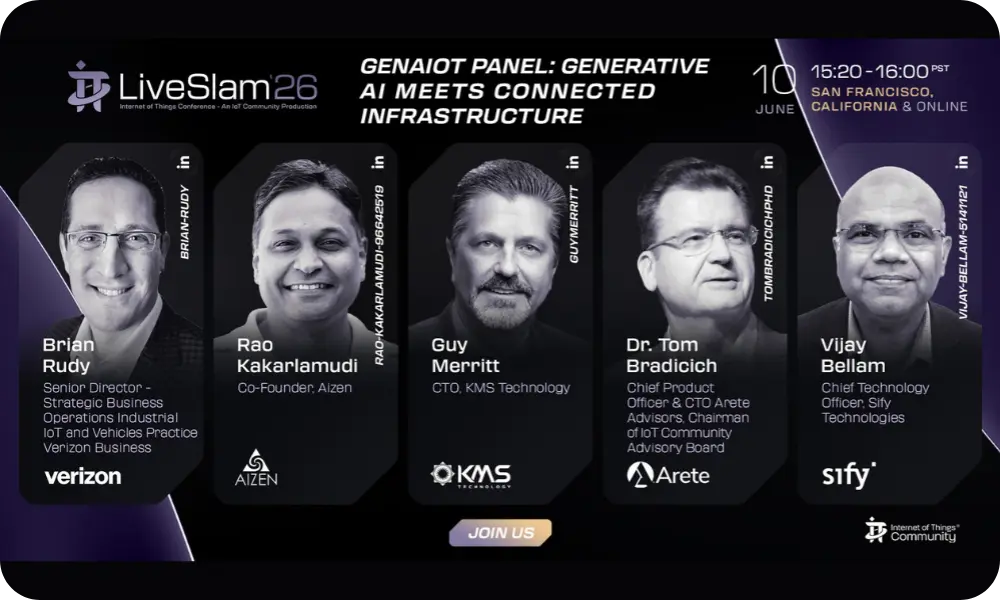
Most enterprises have already deployed AI. Far fewer can say it’s paying off. At IoT Slam Live 2026, IoT Community’s hybrid flagship event bringing together enterprise and industrial leaders to share real world outcomes, architectures, and roadmaps at the intersection of 5G, mobile edge compute, GenAIoT, and agentic AI, a panel of technology leaders sat down to examine where generative AI is beginning to intersect with connected infrastructure and operational systems, and why so many organizations still can’t answer a simple question: is it working?
The moderator opened with two data points that framed the entire discussion.
95%
of enterprise generative AI pilots deliver no measurable return on investment.
Source: MIT
Usage is high. Certainty about value is not. That gap set up a wide-ranging conversation covering data platforms, edge and cloud division of labor, digital twins, the lab-to-production gap, and the governance frameworks starting to catch up with all of it.
The Panelists
Guy Merritt, Chief Technology Officer, KMS Technology
A C-suite technology executive with 35 years of engineering leadership, Guy advises organizations on modernizing legacy systems through IoT, cloud-native platforms, and AI-driven architectures. He is the author of Proactive Risk Management: Controlling Uncertainty in Product Development and leads technology strategy and innovation initiatives across multiple industry verticals.
Dr. Tom Bradicich, Chairman, IoT Community Board of Advisors; Chief Product Officer and CTO, Arete
Tom leads AI and software development for forensics, response, and ransomware management products at Arete, and sits on the boards of Sify Technologies and Sify Infinite Spaces. He previously held senior roles at IBM, National Instruments, and Hewlett Packard Enterprise, where he led the global Servers and Edge Systems and Software business and helped launch several first-of-a-kind product categories, including Converged Edge Systems and OT edge management platforms.
Brian Rudy, Verizon
Brian leads Strategic Business Operations for Verizon’s Industrial IoT and Automotive organization, coordinating front- and back-office functions across the practice. He has spent 31 years with Verizon and its legacy companies, with recent focus on the cellular connectivity practice that brings wireless technology into IoT and fixed wireless access solutions for customers.
Pete St. Pierre, Director of Product Management, Oracle Cloud Infrastructure IoT Platform
Pete led the team that launched Oracle’s first OCI-native IoT platform and now leads product strategy and go-to-market for OCI IoT. With more than 30 years of enterprise software and product leadership experience spanning Oracle, Cisco, and Sun Microsystems, his background includes deep involvement in IoT standards work, including a term as President of the IPSO Alliance.
Rao, Co-Founder, Aizen
Rao brings more than 30 years of experience designing mission-critical AI, BI, and transaction systems for global enterprises. He previously co-founded Esgyn, an enterprise big data platform, and held engineering and architecture roles at Hewlett-Packard, Compaq, and Tandem Computers, where he worked on fault-tolerant and parallel computing systems.
From Data to Action: Embedded AI at the Edge Is Already Working
Asked how embedded AI at the edge unlocks new economic value, Brian offered a line he’s used before: “IoT already is everywhere. AI is going.” IoT supplies the data AI needs and the means to act on it, but making the edge, near-edge, and cloud all talk to each other well starts with the network layer itself. Brian described embedding agentic AI directly into Verizon’s network fabric, so that changes once requiring a truck roll, like spectrum allocation, can now be recognized and acted on by the platform in real time.
He grounded the idea in concrete deployments. A Verizon “light sense node,” essentially a street light sensor deployed by the millions across the country, doesn’t just report ambient light. When it detects a flickering luminaire or pole damage, it doesn’t merely send an alert, it opens a ticket and dispatches a technician automatically. Similar patterns are showing up elsewhere: a landfill gas capture customer moved from manually walking wells to continuous, near real-time monitoring, and a company called Floor Cloud now continuously verifies that poured flooring cures properly rather than discovering a failure after the fact.
The Data Foundation Everything Else Depends On
Nearly every other topic on the panel traced back to the same root issue: whether an organization’s data is actually ready for AI to act on.
Augmenting the Data Platforms You Can’t Rip and Replace
Guy tackled a problem nearly every enterprise faces: decades of data infrastructure that can’t simply be replaced to make room for AI. “The standard answer is to rip and replace,” he said, “but that’s the challenge we’re faced with.” Instead, organizations are left choosing how to augment what they have, whether through a RAG implementation with a vectorized database, which introduces its own duplication and inefficiency, or an agentic approach using tools against the existing data.
Either path runs into the same wall: the technology is only as good as the data underneath it. “It’s no better than the data itself,” Guy said, describing client engagements where teams jumped straight into building AI systems on top of uncurated spreadsheets sitting on someone’s desktop. Getting the foundation right, governance, curation, quality, isn’t glamorous, but skipping it is why so many AI initiatives stall before they show any return.
Digital Twins as the Iterative Model for Agentic Practice
Pete connected the digital twin conversation directly back to that same data problem. Building a canonical representation of a device, like a single model for an HVAC unit rather than a hundred separate variants, lets developers clean and land data in a form agentic tools can actually query. Once that structure exists, Pete explained, agents can surface relationships in the data that developers didn’t know to look for when they built the twin in the first place, closing a loop between the model and reality.
He offered a developer-experience example that lands the point concretely: instead of manually checking credentials and connectivity when an IoT proof of concept suddenly stops receiving data, a developer can ask the database directly why device 12 has gone quiet, and get back that the data landed in a rejected table because an adapter changed on a specific date. “The agentic tools give you not just the ability to have better business outcomes,” Pete said, “but also improve the developer experience along the way.”
The Gap Between the Lab and Production
Rao took on why so many solutions that work cleanly in a lab fall apart in production. In a lab, a small, static dataset is enough to validate a model. Production is a different animal entirely. “It’s not a static data source now,” Rao said. “It’s a dynamic data source.” Real-time ingestion, incremental data, sensor failures, and the guardrails needed to handle all of it rarely get tested until operations teams push back. Rao framed the underlying flow as three A’s: acquire the data, analyze it, and act on it, with feedback looping back through the cycle. Skipping the operational realities of that loop, he argued, is where most of the lab-to-production gap actually comes from.
Where Agentic AI Actually Delivers ROI
Circling back to the MIT and McKinsey numbers that opened the panel, the conversation turned to why so many agentic AI initiatives fail to show returns, and what separates the ones that do.
Where It Delivers, and Where It Gets Oversold
Brian was candid about separating hype from results. Agentic AI performs best against a well-defined workflow that an organization is willing to re-engineer around it, and it performs especially well on complex, well-documented workflows involving data volumes no human team could keep up with manually. It breaks down, in his experience, when teams simply overlay agentic AI onto an unchanged legacy workflow and then blame the technology when it underperforms. “It was poor engineering,” he said. “You didn’t engineer within the parameters to have this work.”
The oversold cases cluster around mission-critical, regulated environments, where organizations need to prove why a system did what it did and discover their logging wasn’t built to support that. “There’s no regulator giving you a pass on that,” Brian said. His bottom line: “Right now we advocate agent assistance. Tomorrow’s going to be agent autonomy. But it’s agent assistance right now.”
ROI Requires Re-Engineering the Whole Workflow, Not Just a Piece of It
Guy connected the ROI problem directly back to workflow design, sharing that KMS saw a 10x increase in code generation from agentic software engineering approaches two years ago, without a corresponding improvement in how fast projects actually shipped. The reason: the team hadn’t re-engineered the testing process to match. He offered a simple metaphor for the trap: getting to the airport two hours early doesn’t get your flight there any sooner if the plane still takes off at six. Speeding up one stage of a process doesn’t help if the rest of the workflow, and its bottlenecks, stay exactly the same.
Tom tied this back to a discipline the room recognized immediately. “That’s really hard,” he said, “because you don’t own the end to end.” His prescribed method: baseline the current state, understand the bottlenecks, re-engineer, experiment, and repeat, a process some in the room recognized as the return of classic business process re-engineering, now with agentic tools attached.
Architecture Decisions: Edge, Cloud, and Security
The panel spent significant time on where workloads should actually live, and why that decision is as much about security as it is about latency.
Edge AI and Generative AI: A Division of Labor, Not a Merger
Guy offered a framing for how edge AI and generative AI actually relate to each other. “I don’t really see it necessarily as a merger,” he said, “but I see it as a division of labor.” Traditional machine learning sits closest to the sensor, optimized for fast inference where speed matters most. Generative AI sits a layer above, reading and reasoning over that data, functioning more like an advisor that can propose a plan, while agentic capability is what actually executes it.
Pete extended the same logic to the classic edge-versus-cloud debate: decisions bound by latency belong at the edge, close to the compute, while decisions that require correlating across multiple edges belong in the cloud, where a single data lake can bring everything together for generative AI to work across. “The companies that can do that objectively for their clients will win,” Pete added, “because the clients will see through” vendors pushing workloads to wherever benefits their own product.
Trust, Security, and the Case for a Single Cloud Environment
Asked how to think about trust and security once generative AI is connected to live operational systems, Pete framed it as a data placement problem first. Some data has to stay local, which pushes logic down to the edge, but realizing the full value of generative AI means bringing real-time data together with the rest of the business: supply chain, HCM, ERP. That convergence, in his view, only really happens in the cloud. The biggest security risk isn’t any single vulnerability, it’s policy fragmentation. “One of the biggest problems with security is when you try to manage policy in too many different places,” Pete said, arguing that a unified cloud environment with consistent network- and device-level policy is what actually lets organizations deploy end-to-end workflows without gaps.
Keeping AI Accountable: Determinism and Governance
The panel closed on the discipline required to deploy agentic AI responsibly, both in how decisions get made and how they get regulated.
Reconciling Probabilistic Reasoning With Deterministic Action
Rao addressed a tension that runs through every agentic deployment: LLMs are strong at reasoning and recommendation, but their output isn’t repeatable in the way regulated or operational systems require. He described a customer who wanted to apply conversational AI directly to a Type 2 complaint process, where a non-deterministic, non-repeatable answer simply wasn’t acceptable. The resolution isn’t abandoning LLMs, it’s keeping a layer of fixed, deterministic rules between the model’s reasoning and any action actually taken. “You still, when you are taking actions, you need to apply your rules deterministic,” he said. Treat the LLM as an advisor, not the decision-maker of record.
Governance: Four Things Every Platform Needs
Closing on the role of regulatory frameworks like the EU AI Act and NIST AI guidelines, Rao laid out four requirements he considers non-negotiable for any platform handling AI-driven physical infrastructure: auditability and explainability built into the platform itself rather than left to the solution builder, strict data residency controls so information doesn’t quietly cross jurisdictions, clear governance over who can access and control what, and a human who remains on the loop to monitor outcomes and make the final call. As the panel wrapped, the consensus was less about whether AI belongs in connected infrastructure and more about the discipline required to deploy it responsibly: humans in, on, and around the loop, at every stage.
FAQ
1. What does GenAIoT mean?
GenAIoT refers to the intersection of generative AI and the Internet of Things, where generative and agentic AI capabilities are applied to connected infrastructure and operational systems to interpret sensor data, reason about it, and increasingly take action on it.
2. What is the difference between edge AI and generative AI in an IoT context?
Edge AI, typically traditional machine learning, handles fast, low-latency inference close to the sensor where speed matters most. Generative AI operates a layer above, reasoning over aggregated data and proposing plans, while agentic AI is the layer that actually executes those plans as autonomous action.
3. What should organizations look for in an AI governance framework for connected infrastructure?
Panelists highlighted four requirements: auditability and explainability built into the platform itself, strict controls over where data can reside and cross jurisdictions, clear governance over who can access and control systems, and a human who remains on the loop to monitor outcomes and approve key decisions.
TAGS

Written by
CTO
Guy is an award-winning author and experienced technology executive who has led strategy, product innovation, engineering, and cloud-based solutions across Deloitte, startups, and a range of global industries.