
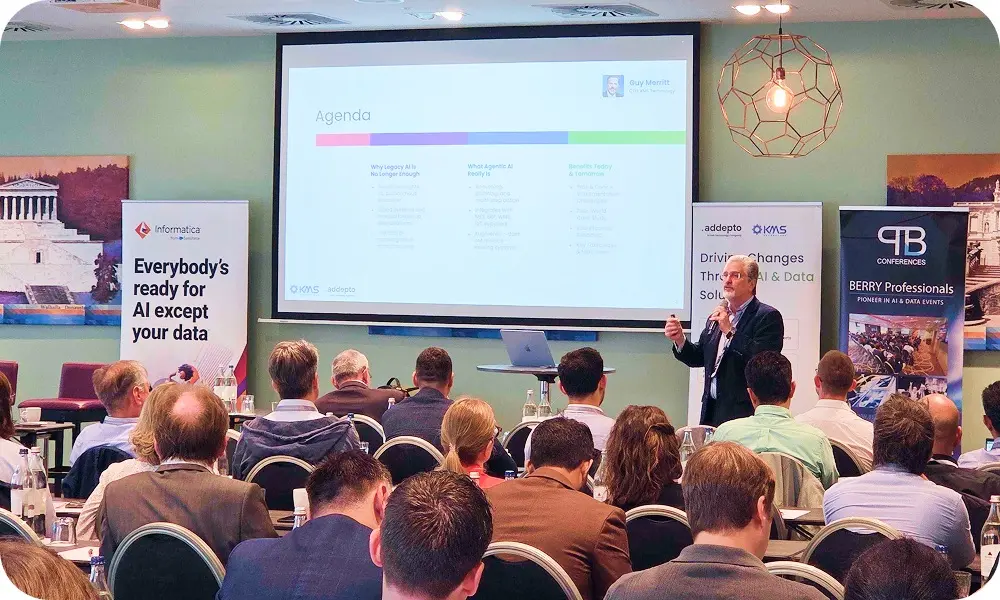

Manufacturing leaders today aren’t struggling to access data. They’re struggling to act on it fast enough.Guy Merritt | CTO | KMS Technology
That was the opening challenge Guy Merritt, CTO of KMS Technology, prese to the room at the Data in Manufacturing & Smart Industry Summit 2026 in Munich.
Over two days, the conference brought together data leaders, manufacturing executives, IoT specialists, and AI practitioners to explore how manufacturers can turn growing volumes of industrial data into faster, smarter operational decisions. This is where agentic AI in manufacturing becomes different from traditional analytics: it helps teams move from detecting operational issues to coordinating and executing the next best action.h ending with “the new validation gap emerges”.
As part of the event, KMS Technology CTO Guy Merritt took the stage as a featured speaker with a session titled Agentic AI on the Factory Floor: Autonomous Intelligence Across Supply Chain, Manufacturing & Reverse Logistics
In this session, Guy explored how manufacturers can move beyond traditional analytics and isolated AI pilots by introducing autonomous AI agents capable of reasoning, coordinating, and acting across supply chain, production, and reverse logistics workflows without replacing existing ERP or MES systems.
Here’s a full recap of what he covered.
Manufacturing Has an Action Problem, Not a Data Problem
Most manufacturers today already have some level of AI in place. Computer vision systems are monitoring quality lines. Predictive maintenance models are watching equipment health. Analytics dashboards are surfacing operational insights across plants and supply chains. The issue is that the workflow often stops there. An anomaly gets flagged, but a person still has to investigate the issue manually. By the time action is taken, the disruption has often grown larger and more expensive.
During the session, Guy emphasized that this gap between insight and execution is where many manufacturers are now losing time, efficiency, and competitiveness.
Traditional AI tells you something is wrong.
Agentic AI helps resolve it.
That distinction resonated strongly with attendees navigating tighter margins, growing supply chain complexity, and increasing pressure to make operations more resilient and responsive.
What Is Agentic AI in Manufacturing?
One of the most valuable parts of the discussion was clarifying what “Agentic AI” really means in practice. Rather than functioning as a passive analytics layer, an agentic system is designed to reason through problems, plan next steps, and take action autonomously within defined operational guardrails.
These systems continuously interact with existing enterprise platforms such as ERP, MES, WMS, CMMS, and IoT environments without requiring organizations to replace the infrastructure they already rely on. Guy explained that true agentic systems operate through an ongoing decision loop.
They observe operational events, evaluate context across multiple systems, determine the next best action, execute through approved tools, and continuously improve based on outcomes. In manufacturing environments, agentic AI connects operational data, business rules, and enterprise systems so actions can be coordinated across production, maintenance, inventory, and supplier workflows.

For manufacturers, this capability is what allows organizations to move from reactive workflows toward real-time operational coordination. Instead of waiting hours or days to coordinate responses manually, agentic systems can react in seconds.
They can automatically coordinate supplier communications, reroute production, optimize maintenance scheduling, or trigger inventory replenishment while still keeping humans involved for approvals and oversight where needed.
Agentic AI in Manufacturing Use Cases With Measurable ROI
One of the strongest themes from Guy’s session was that Agentic AI is already delivering measurable operational value today, especially in areas where manufacturers traditionally lose time coordinating manual decisions across disconnected systems. A key example discussed during the summit was predictive maintenance.
While many manufacturers already use AI to predict equipment failures, the response process after the alert often remains manual and fragmented across systems.
Agentic AI closes that gap by validating predictions against maintenance history, checking parts availability, identifying optimal downtime windows, and automatically creating work orders and procurement actions within ERP and CMMS platforms. All actions operate within defined governance rules, including approval thresholds and audit logging.

Beyond maintenance, Guy also shared how manufacturers are applying agentic systems across broader manufacturing operations, including:
- Real-time demand sensing and autonomous reordering to reduce inventory costs and improve supplier coordination
- Automated defect analysis and production rerouting to minimize downtime on the factory floor
- Autonomous returns triage to accelerate reverse logistics and improve remanufacturing decisions
What makes the impact meaningful is not any single use case on its own, but the way these systems coordinate decisions across the broader manufacturing ecosystem.
Implementation Challenges and How Manufacturers Can Overcome Them
One of the most practical parts of Guy’s session focused on the realities of implementing Agentic AI in manufacturing environments. While the technology offers significant operational value, successful adoption depends on solving several foundational challenges around systems, governance, and organizational readiness.
Fragmented Manufacturing Data and Legacy Systems
Many manufacturers still operate across disconnected ERP, MES, WMS, and IoT platforms that were never designed to work together seamlessly. Inconsistent asset naming, siloed operational data, and plant-specific integrations often make autonomous coordination difficult.
To overcome this, Guy emphasized starting with a strong data and integration foundation rather than attempting large-scale transformation immediately. Manufacturers should begin with one well-connected use case, use API-first integrations, and adopt common industrial standards such as ISA-95 to create cleaner data contracts across systems.
Governance and Security for Manufacturing AI Agents
As autonomous systems begin making operational decisions, governance becomes critical. Manufacturers must address approval controls, auditability, GDPR considerations, and emerging risks such as prompt injection or unreliable tool execution.
Recommendation from KMS Technology
Embed governance directly into the runtime architecture itself.
Agentic systems should operate through constrained tool access, defined approval thresholds, role-based permissions, and full audit logging so organizations maintain visibility and control over every autonomous action. For manufacturing AI agents, governance is not a control layer added later. It is part of the runtime design that determines what actions an agent can take, when approval is required, and how decisions are audited.
Building Human Trust in Autonomous Manufacturing Workflows
Adopting Agentic AI is not only a technology shift, but also an operational one. Many organizations are still transitioning from “human-in-the-loop” workflows, where people execute every action manually, toward “human-on-the-loop” models focused on oversight and escalation management.
Guy recommended introducing gradual pilot programs with measurable KPIs over 8–12 weeks to help teams build confidence incrementally. He also highlighted the importance of new operational oversight roles, such as “Agent Captains,” who supervise autonomous workflows and manage escalations when needed.
Ultimately, the goal is not to remove humans from operations, but to reduce repetitive coordination work so teams can focus on higher-value strategic decisions.
Practical Agentic AI Roadmap for Manufacturers
Rather than recommending large-scale transformation all at once, Guy outlined a phased adoption strategy designed to help manufacturers move incrementally while generating measurable ROI at every stage.
| Phase 1 | Assess & Pilot (Weeks 8–12)
Pick one process: quality rerouting, reordering, or returns. Deploy first agent, measure KPIs. |
| Phase 2 | Scale Across Manufacturing & Supply Chain
Add scheduling, demand sensing, and supplier agents. Introduce Agent Captain roles. |
| Phase 3 | Extend to Reverse Logistics & Full Autonomy
Add returns, remanufacturing, and recycling agents. Close the circular production loop. |
Throughout every phase, humans should remain in control. The purpose of Agentic AI is not to eliminate operational teams, but to remove the manual bottlenecks that prevent them from operating at higher strategic levels.
Real-World Success Story: Aviation MRO
35%
Faster Response to Quoting
22%
Reduction in Inventory Holding Costs
35%
Overall Productivity Gains Across the Organization
35%
Overall Productivity Gains Across the Organization
6 Months
ROI Positive of full deployment
To bring the discussion into a real operational context, Guy shared a case study involving a mid-sized aviation MRO organization that partnered with KMS Technology to modernize quoting, documentation research, and reverse logistics processes.
The company already had computer vision systems and basic ERP infrastructure in place, but many workflows still depended heavily on manual coordination. Teams spent large amounts of time searching technical documents, preparing repair quotes, managing contracts, and coordinating inventory returns.
KMS introduced a set of specialized agents that worked alongside the company’s existing ERP environment to automate and streamline key operational workflows, including:
- Quoting and Contract agents: automate repair quotes and contract review
- Research and Routing agents: identify correct documents and defect-to-reroute decisions
- SC & Reverse logistics agents: parts inventory returns & remanufacturing
With the help of KMS Technology, the organization has successfully transformed their heavily manual operational workflows into a faster, more connected system, achieving measurable gains in productivity, response time, and inventory efficiency within just six months.
Looking Ahead
The Manufacturing & Smart Industry Summit 2026 made one thing very clear: manufacturers are moving beyond experimentation and looking for practical ways to operationalize AI at scale.
The conversation is shifting away from dashboards and isolated pilots toward systems that can coordinate decisions autonomously, respond to disruptions in real time, and create measurable operational impact across entire manufacturing ecosystems.
At KMS Technology, we believe the organizations that succeed in this next phase of Industry 4.0 will be the ones that start pragmatically, focus on operational value first, and build governed autonomy step by step.