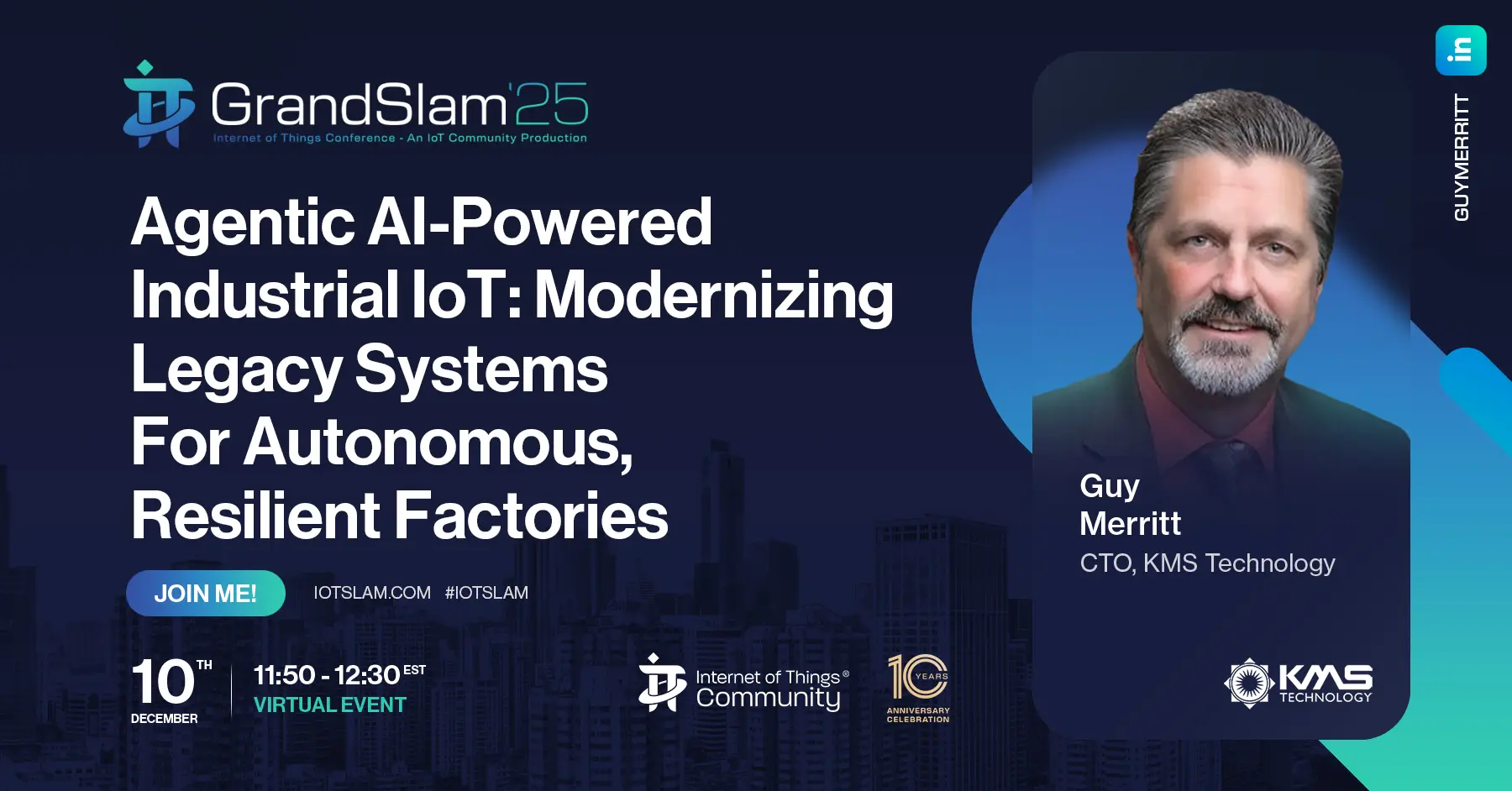
Industrial IoT (IIoT) platforms — built on legacy protocols, siloed data, and reactive analytics — are struggling to deliver the real-time manufacturing demands in 2026 and beyond. Agentic AI changes everything: autonomous agents that perceive, reason, plan, act, and learn can transform rigid IIoT architectures into self-optimizing systems that predict failures, dynamically reconfigure production, and reduce factory downtimes.
At the IoT Grand Slam Conference, Guy Merritt, Chief Technology Officer at KMS Technology, discussed how manufacturers can move beyond legacy industrial IoT systems and begin building autonomous, resilient factories powered by Agentic AI.
Throughout the session, Guy revealed a practical roadmap for evolving legacy IIoT (SCADA, PLCs, historians) into agentic architectures using Agentic AI design patterns, edge-based reasoning, and multi-agent orchestration. You’ll also learn:
- Modernization frameworks for your IIoT systems.
- Strategies to maintain safety, governance, and OT/IT convergence in an agentic era.
- Real-world case studies from manufacturing.
For those who missed the live session, you can watch the recording below or continue reading for the full recap.
The $3 Trillion Problem: Why Legacy Industrial IoT Systems Are Falling Short
Despite more than a decade of investment in Industrial IoT, manufacturers continue to struggle with the same core issues:
$1.5-$3
trillion in global manufacturing downtime annually.
90%
of AI pilots never reach production.
IIoT
= reactive, siloed, brittle
“That is a monumental number if you just think how much lost productivity occurs simply because of unplanned downtimes for equipment,” Guy emphasized.
Even with traditional AI for quality inspection using computer vision and predictive maintenance, most factories are still struggling with unplanned downtime. The reason is that legacy IIoT systems are fundamentally reactive.
“Our legacy AI and IoT, in the simplest words, will tell you what happened or what might happen. But actions we take are still manual, and we’re still wrestling to interpret data, coordinate systems, and execute remediation under time pressure.” Guy emphasized that yesterday’s tools are no match for today’s urgency, and the true cost isn’t just measured in dollars.
What Is Agentic AI-Powered Industrial IoT?
The old model that simply reports on “I will tell you about it” is no longer sufficient. Manufacturing leaders are turning to agentic AI with the ambition to transform rigid IIoT architectures into self-optimizing systems that can say “I will do something about it.”
An agentic AI-powered industrial IoT system is built from autonomous agents that can:
Understand
context across sensors, assets, and workflows.
Reason
about causes, constraints, and trade-offs
Plan
multi-step remediation strategies
Act
safely within defined authority
Learn
continuously from outcomes and human feedback
“We’re moving into a world where we have autonomous agents that can self-diagnose, monitor, and take action. And there are a few elements that are hallmarks about this agentic approach: it’s dynamic and adaptable,” Guy notes.

He illustrated the difference with a pump failure scenario. In traditional IIoT systems, a predictive model flags abnormal vibration, an alert is generated, and an engineer investigates, diagnoses root cause, and decides next steps.

Meanwhile, in an agentic AI-powered industrial IoT system:
- The prediction engine still detects the anomaly
- The Understanding Agent: gathers context (asset history, manuals, maintenance backlog)
- The Reasoning Agent: evaluates likely failure modes
- The Planning Agent: determines remediation options
- The Act Agent: executes safe actions:
- Reduces pump RPM
- Orders a replacement part
- Schedules work in CMMS
- Notifies operators of every action taken

What makes this fundamentally different from rules-based automation is that the agent was not explicitly programmed with those steps. Instead, it reasoned and planned using context, tools, and constraints, then acted within predefined safety measures.
Legacy Industrial IoT vs. Agentic AI-Powered IIoT
Guy emphasized that successful agentic AI-powered industrial IoT systems rely on well-understood design patterns, not experimental AI research. Key patterns discussed included:
- Tool Use: allows AI to autonomously leverage external tools and resources, expanding its capabilities beyond language processing.
- Multi-Agent: facilitates multiple AI agents working together, each with specialized roles to address complex problems more effectively.
- Reflection: enables AI to evaluate and improve performance by analyzing its own outputs, decisions and reasoning processes.
- Planning: empowers AI to break down complex tasks into manageable steps, developing structured approaches to problem solving.

Guy drew a clear analogy, “each agent becomes like its own microservice and instead of thinking about applications, we start thinking about workflows.” Together, these patterns form the foundation for industrial-grade autonomy.
How To Deploy an Agentic IIoT Platform
Transitioning to an agentic AI-powered industrial IoT platform is a commitment to meaningful change, but with one step at a time. Guy reinforced the importance of “crawl, walk, run” as the guiding principle, noting that many AI pilots fail because they never anchor to real production problems.
Phase 1: Prepare (Months 1-3)
- Inventory data and protocols (e.g. Modbus, OPC-UA)
- Selecting and deploying edge gateways
- Build graph ontology focused on assets
- Determine system architecture
- Decide on LLM and if fine-tuning is required
Phase 2: Pilot (Months 4-6)
- Ingest historical data into knowledge graph
- Pilot single agent on one line (i.e. crawl, walk, run)
- Baseline MTTR reduction or some KPI that you can easily measure
- Build a roadmap with clear problem statements
Phase 3: Scale (Months 7-12)
- Multi-agent orchestration
- Digital twin integration
- Closed-loop autonomy
- Design an on-going monitoring program to determine when model drift happens
- Know when to possibly do model adjustments
Crucially, agentic behavior does not mean uncontrolled automation. In industrial environments, autonomy must be bounded, explainable, auditable, and governed — a theme that ran throughout the session.
Real Results and Moving Forward
The theory is compelling, but the results are what matter in the session. Guy shared a case study from a ceramic manufacturing facility that implemented this agentic AI framework and achieved incredible results:
- 18.6%: RUL accuracy improvement
- 43%: unplanned downtime reduction
- 74.3% to 82.7% OEE improvement
- 19% reduction in MTTR
As we move toward 2026, the manufacturing floor is evolving from static monitoring to a dynamic ecosystem of self-optimizing agents. Through federated learning, edge computing, and distributed intelligence, the agentic AI framework enables intentional, goal-oriented monitoring agents to form self-organizing predictive maintenance ecosystems.
Closing the session, Guy Merritt highlighted that with the right architecture — grounded in safety and real-time data — Agentic AI is a proven strategy for the manufacturing industry to reclaim the trillions lost to inefficiency.