
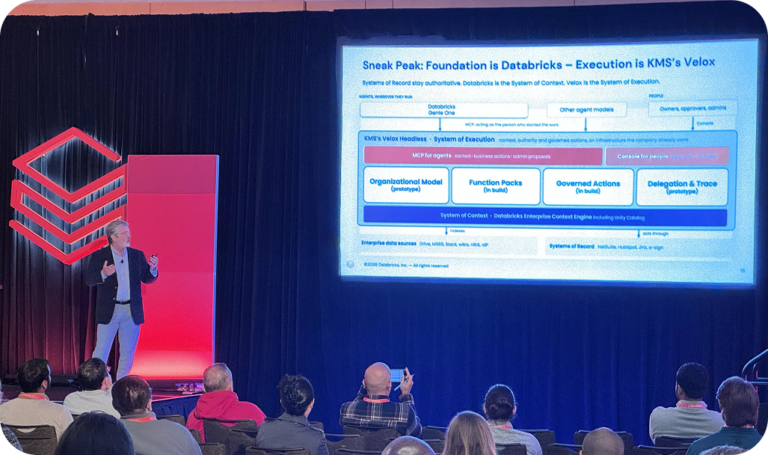
Every company wants AI agents that can answer questions and take action. Very few have the data foundation those agents need to get it right.
That was the message KMS Technology CTO Guy Merritt brought to the Databricks Data + AI World Tour in Atlanta on November 10, in a session called The Headless Lakehouse: Modernizing Your Data Foundation for AI Agents. His argument was simple: the move from dashboards to AI agents is real, but agents built on untrusted data, hidden business logic and inconsistent metrics don’t fix those problems. They multiply them.
Here’s a recap of the session: the vision, the blockers, and the practical path forward.
The vision: skip the dashboard, get the answer
Guy opened with the shift analytics teams are living through. For years, the job was building reports. People who needed an answer went looking for the right dashboard, then interpreted it. In a headless model, that changes. Governed data and business meaning are separated from any single interface, so people and AI agents can ask questions directly and get trusted answers back.
The work moves from building reports to curating trusted answers with governed actions.
What “headless” actually means
Guy broke the idea into three parts, all built on Databricks:
- Governed data. One governed copy of the truth in Unity Catalog, with access, lineage, quality and audit applied once, for people and agents alike.
- Shared semantics. Business definitions like revenue, churn and margin captured as Unity Catalog metric views, defined once and versioned like code.
- Any interface. Genie, AI/BI dashboards, Databricks Apps, Slack, Teams and external agents via MCP, all reading the same definitions.
The principle underneath: define meaning once, then serve it everywhere.
Answers become team assets
With Genie, individual questions stop being one-off exchanges. Curated Genie Agents are grounded in a team’s own tables, metrics and instructions. A strong Genie One thread can be saved as a reusable agent. Agent Mode handles multi-step investigations that explain why a metric moved, and shared conversations let teammates build on each other’s analysis instead of starting over.
Two details matter for trust and adoption. Benchmarks, a set of known-good test questions, keep accuracy measurable over time. And because Genie reaches people in Slack, Teams, mobile and over MCP, answers show up where work already happens.
The blockers: today’s analytics problems become AI risks
None of the problems Guy described are new. What’s new is what happens to them when an agent sits on top.
| The problem today | What it becomes with AI |
|---|---|
| Untrusted data. Quality gaps and unclear lineage mean people export and re-check. | Confident wrong answers. An agent answers fluently and instantly, and scales bad data with it. |
| Stranded business logic. Rules are buried in stored procedures, ETL jobs, BI models and Excel. | Agents can’t see the rules. Logic an agent can’t read becomes logic it guesses at, or skips. |
| Inconsistent metrics. “Revenue” means three things in three reports, and meetings debate numbers. | Every answer is debatable. Without one definition, each answer starts an argument, not a decision. |
AI doesn’t fix your data. It scales it.
This was the line that framed the rest of the talk. Analysts have spent years quietly working around gaps in trust, logic and definitions. An agent won’t work around them. It will expose them at machine speed.
Guy put the math plainly: one bad definition times 1,000 agents equals 1,000 wrong answers. And there’s a subtler risk. A dashboard with bad data tends to look suspicious, so people question it. An AI answer with bad data looks authoritative.
The implication: modernize the foundation before you scale the agents.
The path forward: build the governed foundation
Guy laid out three layers on Databricks, and the order matters:
1. Govern. Land critical data in Unity Catalog. Apply access, lineage and quality monitoring, and certify the tables that matter.
2. Define. Lift business logic out of legacy SQL, ETL and BI tools into Unity Catalog metric views. Versioned, tested, owned.
3. Activate. Launch domain Genie Agents on certified metrics, with benchmarks, instructions and a named business owner.
Skipping to step three is the temptation. It’s also how teams end up with the confident wrong answers described above.
Databricks as the system of context
One of the more practical points in the session was what this does not require. Your systems of record stay authoritative. The investment in NetSuite, HubSpot, your HRIS and the rest is preserved. Databricks becomes the system of context that sits across them.
Data flows in from those systems, plus sources like Jira, docs and email, through Lakeflow Connect, Auto Loader, CDC and webhooks. It moves through the familiar medallion layers: raw in Bronze, cleaned and conformed in Silver, and a company data model and data products in Gold. From there it serves Vector Search for RAG over contracts and playbooks, Lakebase for agent state and memory, Databricks SQL and Genie for metrics and natural-language analytics, and Model Serving. Unity Catalog provides one governance layer across all of it, and MLflow handles agent tracing, evaluation and quality scoring.
Guy also called out a write-back rule worth adopting. Agents read context from Databricks, but writes go to the system of record through its own MCP control surface, never straight into Gold. CDC then brings the change back, so the lakehouse and the system of record never disagree for long.
KMS as customer zero: running headless with Velox
Guy didn’t present this as theory. KMS is applying the same approach to its own operations with Velox Headless, the context and authority layer behind the agents KMS uses internally.
The reasoning starts with how people actually work today. Teams already use Genie One, Claude, Copilot, ChatGPT and Grok side by side. When the models are interchangeable, the scarce input is context and authority: what the company knows, and who may decide what. That’s where the durable advantage moves, into data models, decision rights, workflow rules and audit trails.
Velox is built on the Databricks enterprise context engine and inherits permissions through Unity Catalog. It holds the company’s operating model (org structure, roles, decision rights, policies and reference data) along with function packs and governed business actions, with every step traced. People keep the agent they already use, and Velox serves it over MCP, acting as that person. There’s no mandatory portal; a console is used only for approvals, packs and oversight.
Velox is still early. The organizational model and delegation and trace capabilities are in prototype, and function packs and governed actions are in build. The first proof point, also in prototype, is KMS’s own quote-to-SOW process, run from two different agents.
What a request looks like: sending an invoice
Guy walked through an illustrative flow from the internal prototype. Someone in Finance asks Genie One to “send the Acme Phase 2 invoice.” They never open a NetSuite screen. The request goes over MCP as that person, through the Velox gateway, pulls context from Databricks, and runs as a governed action that lands in NetSuite.
Why is that better than the NetSuite UI? Genie can see the contract, unbilled time and rate card in one place, which the NetSuite screen can’t. The $25,000 limit lives in the Finance pack, so every agent and every person hits the same rule. And the write still lands in NetSuite, the system of record, with Change Data Capture bringing the posted invoice back into the lakehouse.
The goal: make every agent company-aware and authority-aware, on infrastructure the company already owns, while preserving the systems of record and cutting the cost of rekeying and reconciling.
Where to start: prioritize what matters most
The session closed with a practical sequence. Rather than trying to modernize everything at once, Guy recommended starting narrow:
1. Pick three to five high-value questions whose answers must be right.
2. Trace their data and logic.
3. Certify those metrics first, since they’re the answers to the high-value questions.
4. Launch Genie with benchmarks, so you can verify the right answer is delivered.
5. Expand function by function.
6. Retire the reports nobody needs.
The takeaway
The headless lakehouse isn’t about removing dashboards for the sake of it. It’s about making sure that when people and agents ask your data a question, they get the same trusted answer, governed the same way, wherever they ask. Agents are going to scale whatever foundation they’re built on. The organizations that get value from them will be the ones that fix the foundation first.
Want to talk through what this looks like for your data? KMS Technology helps companies govern, define and activate their data on Databricks, from Unity Catalog and metric views to production Genie Agents. Get in touch with our team to start the conversation.
TAGS
