
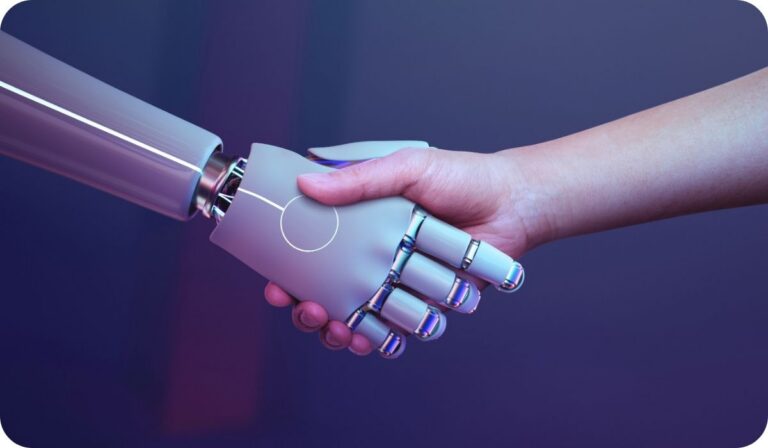
AI Augmentation refers to the use of artificial intelligence technologies to enhance human intelligence and decision-making, rather than replace it.
What does it mean in practice?
Autonomous AI systems that aim to function without human intervention, AI augmentation emphasizes human-AI collaboration.
A model where machines process vast amounts of data, analyze patterns, and suggest insights, while humans apply judgment, creativity, and oversight. This approach is also called augmented intelligence or intelligence amplification, as it is designed to support and extend human cognitive functions. Identifying where AI should augment people rather than replace them is a central question in our AI Consulting Services.
What Is AI Augmentation?
AI augmentation is the use of artificial intelligence to enhance, not replace, human intelligence by combining machine-driven data analysis with human judgment, creativity, and oversight. Also called augmented intelligence or intelligence amplification, it focuses on human-AI collaboration rather than fully autonomous systems. A closely related concept is intelligence augmentation, which looks at the same idea from the perspective of human cognition.
It works by applying machine learning, deep learning, and NLP to process massive data sets, detect patterns, and deliver insights in real time — while humans make final decisions. Examples include AI-powered healthcare diagnostics, financial analysis, legal research, and customer support assistants.
The goal of AI augmentation is to free people from repetitive tasks, improve decision-making, and scale productivity without losing the critical role of human oversight. This approach is increasingly vital in a data-driven world, ensuring that businesses harness AI for smarter, fairer, and more efficient workflows where humans and machines work seamlessly together.
How does AI augmentation work?
AI augmentation uses machine learning and deep learning models to analyze data quickly and detect patterns that may not be obvious to humans. For example, AI tools can process large amounts of data in real time, such as patient records, financial transactions, or customer interactions, and highlight anomalies or trends.
Natural language processing (NLP) plays a key role, allowing AI systems to understand human input and communicate results in natural language. This is what powers AI chatbots, digital AI assistants, and customer service automation. Instead of replacing human agents, these systems act as assistive intelligence, providing data and suggestions to improve human decision-making and productivity.
What is the goal of AI augmentation?
The primary goal of AI augmentation is to enhance human capabilities rather than replace humans. In fields such as legal work, healthcare, finance, and customer support, AI helps professionals by processing data faster than humans ever could.
However, it does not eliminate the need for human oversight. Instead, it frees people from repetitive tasks so they can focus on complex analysis, strategy, and innovation. Augmentation does not automatically raise productivity, though, as we explain in our article on the AI productivity paradox.
In short, AI augmentation is not about building machines that mimic the human mind but about using intelligent technology to support and amplify human intelligence in the workplace.
Why is AI augmentation important?
Nowadays, organizations face vast amounts of data that cannot be processed manually. AI augmentation provides the tools to automate analysis, highlight relevant data points, and deliver insights at scale. This not only improves productivity but also ensures that decisions are informed by more evidence.
Combining generative AI, data analytics, and AI automation, businesses can streamline workflows while keeping humans at the center of the process. How to structure teams around this is covered in our perspective on organizing people and AI for scalable enterprise AI. The technology is developed to enhance human intelligence, creating a future where humans and machines work together seamlessly.
Conclusion
AI augmentation is a necessary step in the evolution of artificial intelligence. It shifts the focus from building autonomous AI to augmenting human intelligence through analytics, natural language processing, and machine learning.
By doing so, it provides real-time assistance, supports human oversight, and enhances decision-making across industries. Rather than replace human intelligence, AI augmentation ensures that humans and machines collaborate, leading to smarter outcomes and greater productivity. Our Five-in-Five AI workshop helps teams pinpoint the augmentation use cases with the highest impact.
TAGS