

72% %
of U.S. physicians said their practice uses AI for at least one task.
Source: American Medical Association
32%
of U.S. adults reported using AI chatbots for health information in 2026.
Source: KFF
Growing adoption among patients and clinicians is creating opportunities for AI to influence more of the care journey, from initial questions to clinical review and follow-up. In 2027, AI is expected to reshape global healthcare and life sciences across three technology-driven themes:
- More connected care: Bringing patient information together to support clinical decisions, continuous monitoring, and easier care navigation.
- Greater delivery capacity: Using AI to streamline documentation, administrative coordination, and clinical trial recruitment.
- Responsible adoption at scale: Building interoperable data, continuous governance, and the workforce skills needed for reliable deployment.
For healthcare leaders, 2027 will bring the challenge of integrating AI into patient journeys that remain clinically accountable and easy to navigate. The following ten healthcare AI trends examine how these themes are progressing and what organizations should prepare for.
1. Ambient AI Becomes Embedded in Clinical Workflows
Ambient AI captures clinical conversations and turns them into draft documentation for clinician review. In 2027, its role is likely to expand through closer integration with electronic health records (EHRs), specialty workflows, and the tasks that follow a patient encounter.
The potential extends beyond producing a note. An integrated assistant could help organize relevant encounter information, prepare draft patient instructions, and reduce repeated data entry. Clinicians could spend less time reconstructing a visit after it ends and more time reviewing the information that matters.
A notable case is Microsoft’s Dragon Copilot, which combines ambient documentation with capabilities such as generating patient-friendly after-visit summaries, connecting encounter capture with the information patients need afterward.
The next phase will likely favor tools that reduce the full documentation workload, including the effort required to correct and finalize an AI-generated draft.
2. Agentic AI Coordinates Administrative Workflows
Agentic AI can connect multiple steps in a process by using software tools within defined permissions. Healthcare offers practical opportunities in referral coordination, scheduling, and preparing prior authorization requests, where staff often move information between several systems.
An agent could check whether a referral contains the required documents, identify missing information, and prepare a follow-up request for staff approval. With Agentforce Health, Salesforce is applying AI agents to workflows that draw on clinical and administrative information to support referrals and patient access.
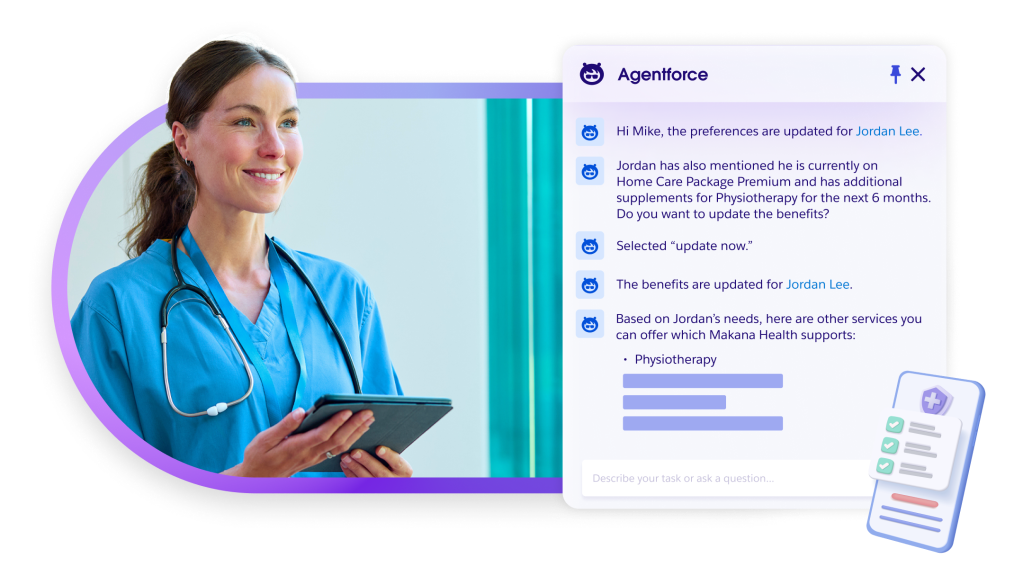
For 2027, a promising direction is greater coordination across these repetitive administrative tasks. The potential value comes from fewer manual handoffs, less time spent checking status, and clearer visibility into where work is delayed.
Adoption is likely to concentrate on processes with defined steps and clear approval boundaries. Staff would retain responsibility for exceptions and decisions that require clinical or coverage judgment.
3. Multimodal AI Builds a More Complete Clinical Picture
Multimodal AI combines information such as clinical notes, medical images, laboratory results, and physiological measurements. Connecting these sources could help AI applications account for patient context that is difficult to capture through a single type of data.
In oncology, future applications could bring imaging findings together with pathology information and treatment history to support specialist review. Google, for example, has introduced a multimodal version of AMIE, a research AI system that combines diagnostic conversations with images and clinical documents to support medical reasoning.
The opportunity for 2027 lies in developing focused tools around decisions that benefit from this broader context. Better connections between data sources could reduce the manual effort involved in assembling information before a consultation or clinical review.
Broader clinical use of these applications still requires further development and validation. Their potential depends on preserving the relationships between findings, timelines, and source records so clinicians can understand how the information fits together.
4. Diagnostic AI Expands Across Specialty Workflows
Diagnostic AI is likely to become more closely embedded in the workflows used to review images, flag possible abnormalities, and prioritize cases for specialist attention. The opportunity extends to helping clinical teams manage growing review volumes and direct their attention to findings that need timely assessment.
Radiology offers a practical example of AI embedded in specialist workflows. Aidoc’s radiology solutions, deployed through its aiOS platform, help flag potentially urgent imaging findings and prioritize examinations for clinical review.
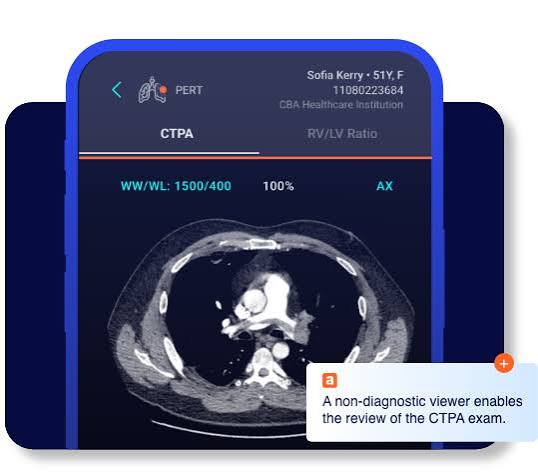
For 2027, potential applications will remain specific to the condition, clinical task, and care setting. A tool used to support screening may serve a different purpose from one designed to prioritize an urgent examination or provide a second review.
Closer integration could make diagnostic assistance available at the point where clinicians need it. The practical value would depend on how well the tool supports timely assessment and fits the capacity of the team handling follow-up care.
5. Remote Monitoring Supports More Proactive Care
AI can add an analytical layer to remote patient monitoring by identifying patterns across readings collected over time. Connected devices and patient-reported information could help care teams recognize changes that warrant attention between scheduled appointments.
A promising direction for 2027 is more personalized monitoring. Applications could assess changes against an individual patient’s baseline and combine several signals to help prioritize clinical review. Care teams could gain a clearer view of which patients may need follow-up and which readings require further context.
The potential extends across chronic disease management and care after discharge, where changes can develop outside a clinical setting. Earlier visibility could support more timely contact and help clinicians decide whether an assessment is needed.
The connection between a signal and a care response remains essential. Monitoring creates a useful opportunity when the information reaches a team able to review it and determine an appropriate next step.
6. Patient-Facing AI Simplifies Care Navigation
Patient-facing AI is likely to play a larger role in helping people prepare for appointments, understand administrative steps, and navigate healthcare services. More useful applications could draw on approved information and connect directly with scheduling, intake, and care coordination systems.
An assistant could gather relevant information before a visit, explain preparation requirements, or help a patient identify the appropriate service. Patients could complete these tasks with fewer calls and repeated explanations, while staff receive more organized information.
A 2026 Nature Medicine trial involving 2,069 patients at two medical centers in China found shorter specialist consultations and better patient-rated communication in the chatbot-only preassessment group compared with usual preparation.
The opportunity for 2027 is to make these interactions part of a connected care journey. Clear language, accessible interfaces, and an easy route to human assistance could make patient-facing AI more useful across different levels of health literacy and digital confidence.
7. AI Streamlines Clinical Trial Recruitment
AI could make clinical trial recruitment more efficient by helping teams compare patient information with complex eligibility criteria. Potential applications include identifying relevant trials, highlighting missing information, and preparing a clearer basis for screening.
In 2027, these capabilities could become more closely connected with the systems used by healthcare providers, research sites, and trial sponsors. Authorized patient information could support an initial assessment of possible matches, while recruitment teams focus their attention on candidates who require further review.
The potential includes reducing the time spent searching records and making suitable trial opportunities easier to identify. Patients may also gain better visibility into options that would otherwise be difficult to find through routine care.
Traceability will remain central to useful matching. Teams need to see which information supports a proposed match, which criteria remain unresolved, and what requires confirmation before formal eligibility and enrollment decisions.
8. Interoperability Becomes Central to Healthcare AI
Healthcare AI becomes more useful when it can access relevant information across the systems involved in a workflow. Patient records, laboratory results, coverage information, and referral status often sit in different applications, creating gaps that limit what an AI tool can do.
For 2027, investment in interoperability is likely to become more closely connected with AI deployment. Standards such as Fast Healthcare Interoperability Resources (FHIR) and modern APIs can support connections between clinical and administrative platforms.
The potential goes beyond retrieving data. Connected systems could let an approved AI workflow prepare information in one application, route it to the appropriate team, and track what happens next. One example is the healthcare data solution in Microsoft Fabric, which includes capabilities for bringing clinical information in FHIR format into a common data environment.
Reliable patient matching, consistent terminology, and clear data provenance remain important parts of that connection. Together, they provide the context needed for AI applications to use information appropriately and support work across organizational boundaries.
9. Continuous Governance Becomes Part of AI Operations
As healthcare AI becomes embedded in daily work, oversight will increasingly need to account for how systems behave after deployment. Model updates, changing patient populations, and new data sources can affect performance over time.
A likely direction for 2027 is more continuous evaluation within the processes used to maintain healthcare software. Organizations could connect model version records, performance monitoring, incident reporting, and change reviews so teams have a clearer view of the AI applications in use.
The potential is more consistent control as adoption expands. Clinical and technology teams could identify emerging problems earlier, assess the effects of a change, and determine whether an application remains appropriate for its approved purpose.
Shared governance practices could also make subsequent deployments easier to assess. Clear ownership and reusable evaluation criteria would give teams a more consistent basis for introducing AI into additional workflows.
10. AI Literacy Becomes a Core Healthcare Capability
As AI takes on more routine work, healthcare professionals will need stronger skills in reviewing its outputs and understanding its limits. Effective use requires judgment about the information a tool produces, the context it may have missed, and when a person needs to intervene.
Training in 2027 is likely to become more specific to roles. Clinicians may practice reviewing AI-generated notes and recommendations, while administrative teams learn to handle exceptions in automated workflows. Technology teams will need to become more AI-native to understand how system changes affect the people relying on them.
The potential extends beyond individual proficiency. A workforce that can describe errors, identify unnecessary correction work, and suggest workflow improvements can contribute directly to better implementation.
Frontline participation will therefore become more valuable throughout adoption. Staff who understand both the work and the AI application can help organizations identify where automation is useful and where additional human review remains necessary.
How Healthcare Organizations Can Prepare for 2027
These trends support a focused approach to investment: select a meaningful problem, establish the evidence needed to proceed, and build the workflow required to sustain results.
1. Prioritize a measurable workflow. Choose a problem such as documentation burden, referral delays, or trial screening effort. Establish the current workload, quality, and turnaround time before selecting a tool. Define the improvement that would justify continued investment.
2. Assess data and integration readiness. Identify the systems, information, and permissions the workflow requires. Address patient matching, incomplete records, terminology differences, and interface reliability. Review how vendors access, retain, and use patient information.
3. Validate the complete workflow. Test the application with representative users and patient populations. Measure errors, correction effort, missed escalations, and differences in performance across groups. Set acceptance criteria and conditions for stopping or restricting use before a pilot begins.
4. Assign ownership and decision boundaries. Name the clinical, operational, and technical owners. Specify which actions require approval, who handles exceptions, and how teams respond during an outage or safety incident. Build a practical way to pause the system and return to an established process.
5. Prepare staff and patients. Involve frontline teams in workflow design and provide training using realistic tasks. Explain the AI application’s purpose and limitations to patients where relevant. Make questions, corrections, and requests for human assistance easy to raise.
6. Scale against demonstrated value. Review safety, adoption, service quality, and financial results together. Include integration, licensing, validation, monitoring, and review effort in the cost assessment. Reevaluate performance after significant changes to the model, data, or workflow.
Bottom Line
Healthcare AI trends for 2027 point toward broader use of clinical assistants, focused administrative automation, and more connected patient information. Progress will depend on whether organizations can translate those capabilities into reliable improvements in everyday care.
A strong strategy starts with a defined workflow and evidence that the application can improve it. Organizations that pair thoughtful integration with clinical evaluation, accountable oversight, and workforce preparation will be better positioned to sustain the benefits.
KMS Technology supports healthcare and life sciences organizations with AI engineering, interoperability, and software modernization. Explore our healthcare and life sciences capabilities to strengthen the systems behind your next AI initiative.